
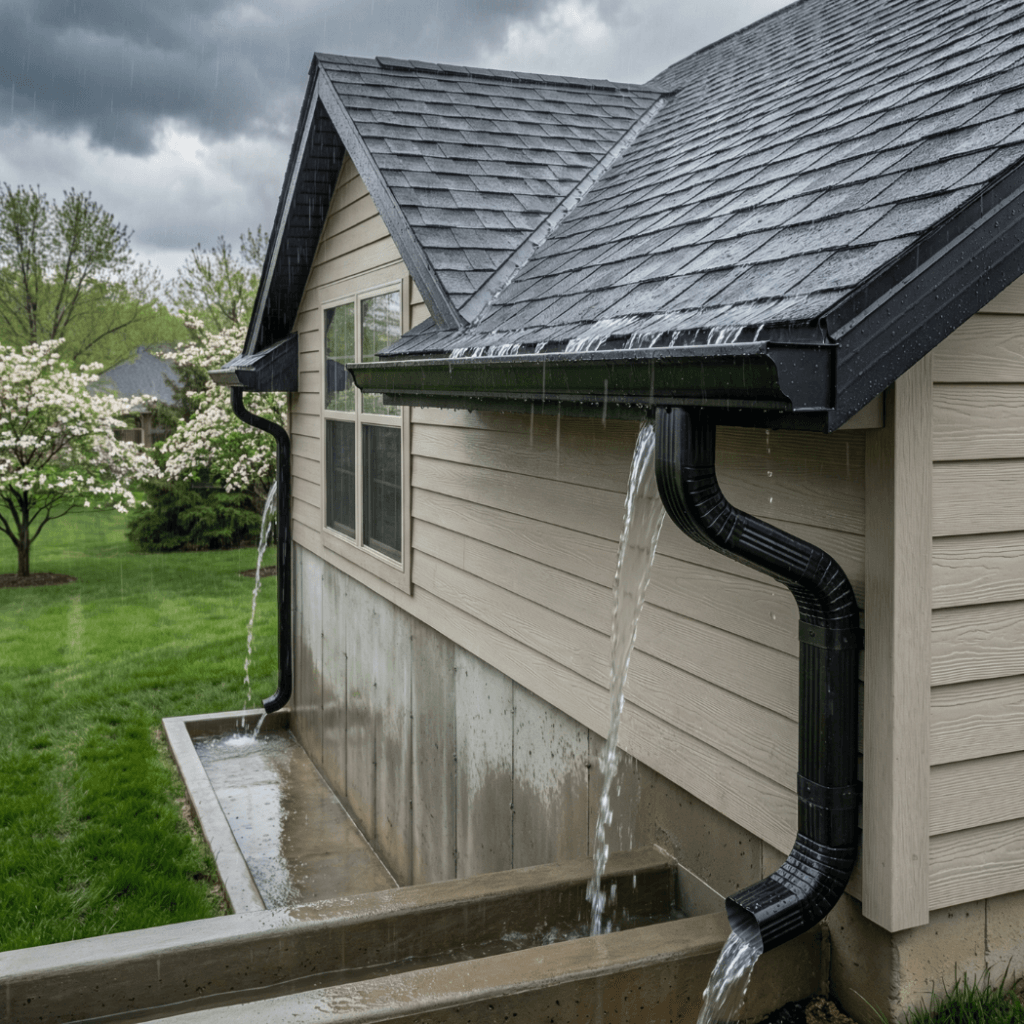
Most homeowners do not think about their gutters until water is pouring over the side in a rainstorm or a basement corner starts smelling musty after a heavy spring. But gutters and downspouts do quiet, important work every time it rains, and when they fail, the problems they cause reach far beyond the gutters themselves. This guide explains how the drainage system works, what the warning signs look like, and how Teague Roofing Plus helps Springfield-area homeowners keep water moving away from their home.
TLDR: Gutters, downspouts, and basic drainage work as a system to move water off your roof and away from your home. In Southwest Missouri, where heavy rain and thunderstorms are common, a failing drainage system can damage your roof edge, rot your fascia, stain your siding, and contribute to foundation and basement moisture problems. Regular checks and prompt repairs keep the whole system working and protect everything underneath it.
You see water pouring over the side of your gutters during a storm and hope it is not a big deal. Most of the time you shrug it off and move on. But that overflow does not disappear. It hits the siding, runs down to the foundation, and soaks into the soil right next to your home every single time it rains hard.
You have a basement or crawlspace you want to keep dry. A damp corner or a musty smell after a storm is your house telling you something. And most of the time, the fix starts at the gutters and downspouts, not at the foundation itself.
The good news is that gutter problems are among the most straightforward exterior issues to address. A simple inspection often reveals the cause, and the repair or upgrade needed is usually far simpler and less expensive than the damage that results from ignoring it.
Why Gutters Matter So Much in Southwest Missouri
Southwest Missouri sees significant rainfall throughout the year, with heavy downpours concentrated in spring and early summer. According to NWS Springfield, the region experiences repeated severe thunderstorm events that can dump large amounts of rain in short windows. When that volume of water hits a roof and flows toward the edge, a properly functioning gutter and downspout system is what stands between a well-protected home and saturated soil, rotted wood, and water in places it should never reach.
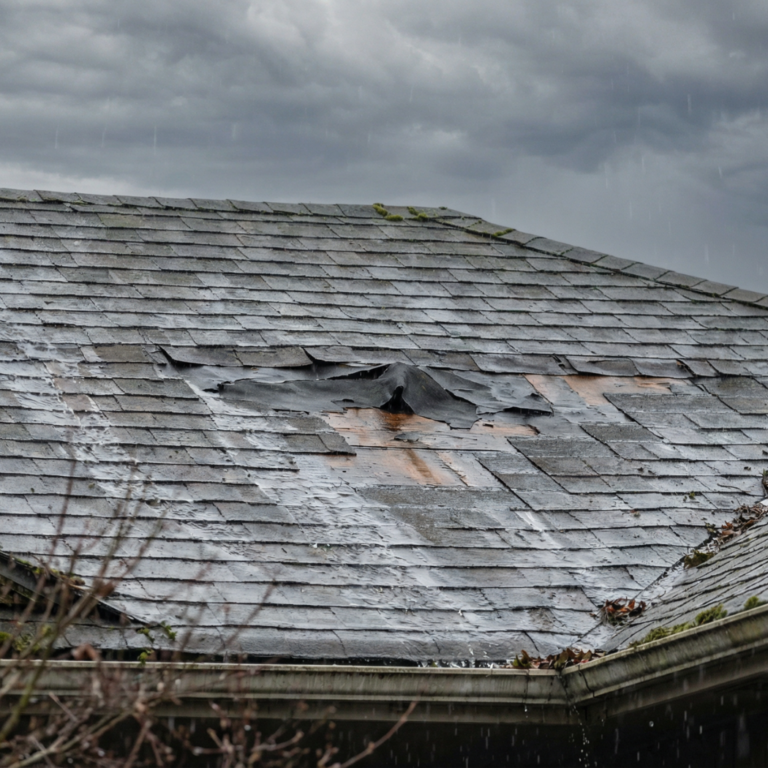
Without working gutters, rainwater flows freely off the roofline in sheets. It soaks the siding directly below the roofline, drops straight to the soil at the foundation, and over time erodes the grading that keeps water moving away from the house. It also backs up under the shingle edge during particularly heavy flows, creating the kind of persistent moisture against the decking and fascia that leads to rot and early roof failure.
Teague Roofing Plus has been working on roofs and exteriors in this region since 1971. We see it regularly: what looks like a roof problem or a siding problem or even a basement moisture issue traces back to gutters that have been overflowing or draining in the wrong direction for years.
| Area | Problem Without Good Drainage | How Gutters Help |
|---|---|---|
| Roof edge and shingles | Water backs up under eave shingles, softening decking and encouraging rot | Gutters channel water off the edge and into the downspout before it backs up |
| Fascia and soffits | Chronic moisture causes paint failure, rot, and structural softening | Gutters mounted properly to fascia keep overflow away from the wood |
| Siding | Overflow and splash saturate siding, causing staining, moisture intrusion, and early failure | Gutters intercept water before it reaches the siding surface |
| Foundation and basement | Water pooling next to the foundation increases hydrostatic pressure and basement moisture | Downspouts and extensions move water several feet away from the base |
| Landscaping and grading | Repeated water drop from the roofline erodes soil and mulch | Gutters and extensions distribute flow across downspout locations rather than concentrating it |
The relationship between gutters and the rest of the home is simple: when gutters work, water goes where it is supposed to go. When they fail, it goes everywhere else.
How Gutters, Downspouts, and Drains Work Together
Think of the drainage system as a chain that has to run unbroken from the top of the roof all the way to a safe discharge point away from the home. Each part of the chain serves a specific role, and when any part fails, the rest of the system cannot compensate.
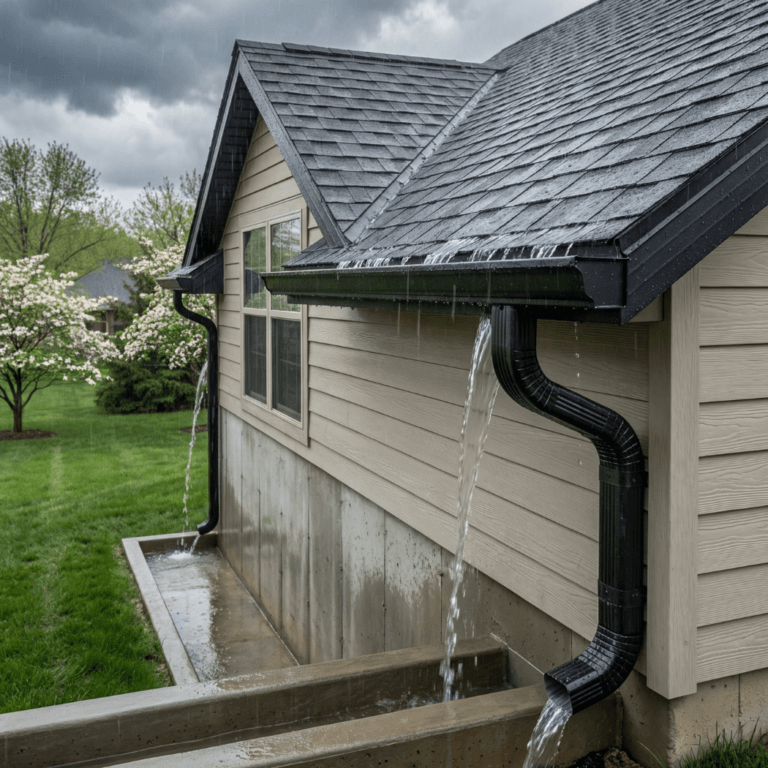
The gutters sit at the roof edge and catch water as it runs off the shingle surface. They slope gradually toward downspout locations so water flows by gravity rather than pooling. The downspouts carry that collected water vertically down the side of the home. At the bottom, elbows and extensions direct water horizontally away from the foundation before it reaches the soil.
Splash blocks sit at the base of downspouts on homes without buried extensions, spreading the water discharge and slowing its erosive force. On homes with grading concerns, buried drainage or longer flexible extensions move water even further from the home before releasing it.
When any link in that chain clogs, sags, disconnects, or is too small for the volume it needs to handle, the system fails and water finds its own path, which is almost always toward something you do not want wet.
Our gutter installation and gutter repair services cover every part of this system, from the gutter itself through the downspout and discharge point.
| Part | Where It Is | What It Does |
|---|---|---|
| Gutter | Along the roof edge, mounted to the fascia | Catches water running off the roof surface and channels it toward the downspout |
| Downspout | Vertical pipe running down the side of the home | Carries water from the gutter to ground level |
| Elbows and joints | Connecting pieces at turns and junctions | Direct water flow around corners and between sections |
| Extensions | Horizontal pieces at the base of the downspout | Move water away from the home before it enters the soil |
| Splash blocks or drains | At the base of extensions or downspouts | Spread discharge and reduce erosion at the release point |
A system with all five parts working correctly handles even heavy SW Missouri downpours without sending water where it should not go.
Signs Your Gutters and Downspouts Need Attention
Most gutter problems announce themselves clearly if you know what to look for. Walk around your home during or after a rain event and watch the system in action. That ten-minute walk is worth more than any dry-day inspection.
During rain, look for water overflowing the front lip or pouring over the back edge of the gutter between the gutter and the fascia. Both mean the water is not getting into the downspout. Water shooting out of seams or joints between sections means those connections have failed. Downspouts that dribble instead of flowing steadily suggest a clog somewhere in the vertical run.
On dry days, look at the gutters from the ground. Sections that sag or pull away from the fascia are no longer draining toward the downspout. Look at the siding beneath the gutters for vertical staining, which indicates chronic overflow. Check the soil at the base of downspouts for eroded areas or pools that stay wet long after rain. Look at the fascia boards visible behind the gutter for any paint peeling, soft spots, or discoloration.
Our roof repair services team often identifies gutter and fascia damage during roof inspections because the two are closely connected. What looks like a roof edge problem frequently starts with a gutter that has been failing for a season or two.
| Sign | What It Might Mean | Next Step |
|---|---|---|
| Overflow during rain | Clogged gutters, failed joint, or undersized system | Clean gutters; if overflow continues, call for inspection |
| Sagging sections | Fasteners have pulled loose or gutter has deformed | Call for repair; sagging sections do not drain properly |
| Water stains on siding below gutters | Chronic overflow reaching siding surface | Inspect and repair gutters; check siding condition |
| Puddles or erosion near foundation | Downspout discharging too close to the home | Add extensions; inspect grading around the discharge area |
Catching these signs early keeps a gutter problem from becoming a siding, fascia, or foundation problem.
How Poor Gutters Can Damage Your Roof, Siding, and Foundation
The connection between gutters and the broader health of a home is direct and documented. IBHS water intrusion research identifies uncontrolled water as one of the primary drivers of both immediate interior damage and long-term structural degradation. When gutters fail, water finds the vulnerable points in the exterior system, and it finds them every time it rains.
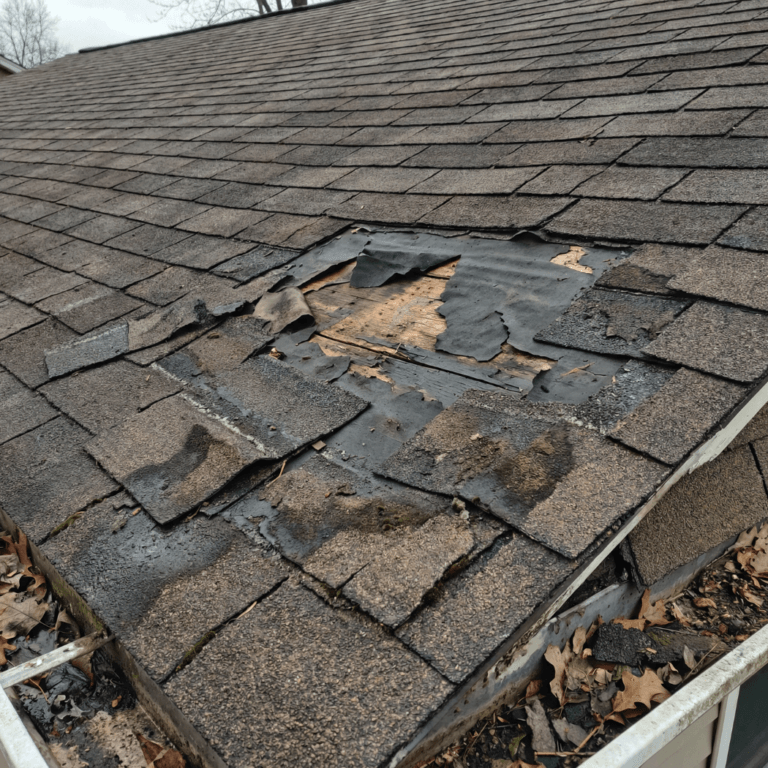
At the roof edge, overflow and back-up push moisture under the shingle edge and against the decking and fascia. Repeated cycles of wet and dry rot wood and compromised the sealant and adhesive bonds that hold roofing components together. Fascia and soffits that stay chronically damp will eventually soften and require replacement, a job that involves removing and re-installing the gutters above them.
At the foundation, water dropped repeatedly at the same location from an unextended downspout saturates the soil directly against the foundation wall. Over time, that pressure increases the likelihood of basement moisture seeping through the wall. Foundation grading that was correct when the home was built can be undone by years of concentrated water discharge in the wrong location.
Energy Star and DOE guidance on attic and roof system durability connects moisture management at the roof edge to conditions inside the attic. When water reaches the decking or insulation, it creates the humid conditions that support mold growth and wood decay even when no visible leak appears inside the home.
Our siding repair team handles siding damage that results from gutter failures, and our full range of exterior services addresses the whole exterior system when multiple components need attention at once.
| Gutter Problem | Immediate Effect | Long-Term Risk |
|---|---|---|
| Overflow at roof edge | Moisture against fascia, shingles, and decking | Rot, early shingle failure, and eventual interior leaks |
| Sagging sections | Water pools in low spots instead of draining | Overflow concentrates in one location; fascia damage accelerates |
| Short or missing downspout extensions | Water drops at the foundation | Soil saturation, grading erosion, basement moisture |
| No gutters or disconnected sections | Full roof runoff reaches the wall and foundation | Widespread siding staining, foundation settlement risk, crawlspace moisture |
Ground-Level Gutter and Drainage Check for Springfield Homeowners
You do not need to climb onto the roof to get a clear picture of how your gutters are performing. Most of the information you need is visible from the ground.
The most useful thing you can do is walk the perimeter of your home during a moderate to heavy rain, staying safely away from any electrical hazards or falling water. Watch where the water goes. Does it flow into the gutters and toward the downspouts, or does it pour over the edge? Does it come out the bottom of the downspout and flow away from the house, or does it pool immediately at the foundation?
On a dry day, look at the gutters from the ground for any obvious sag or separation from the fascia. Walk to each downspout base and look at the soil for signs of chronic erosion or pooling. Check the siding between and below the gutter sections for vertical staining. Look at the downspout joints and elbows for separation or rust.
If anything in this check concerns you, schedule a free roof inspection and our team will evaluate the full system, including the gutters, downspouts, and the roof edge condition above them.
| Item | What to Look For | How Often |
|---|---|---|
| Overflow during rain | Water leaving the gutter before reaching the downspout | Every rainstorm; more urgent in heavy events |
| Sagging sections | Sections that hang lower than adjacent runs | Every spring and fall visual check |
| Separation from fascia | Gap between gutter back and fascia board | Spring and fall; after any major wind event |
| Puddling near foundation | Water collecting within several feet of the home | Check each downspout discharge point after rain |
| Washed-out mulch or soil | Erosion patterns near downspouts or along the roofline | Spring check after winter and major storms |
When You Need New Gutters vs Simple Repairs
Not every gutter problem requires full replacement. A sagging section with a pulled fastener, a leaking joint between two runs, or a clogged outlet are all straightforward repairs that extend the life of a functioning system. A gutter where the metal has rusted through, where sections have been patched multiple times and are still failing, or where the entire run has deformed beyond the point of proper drainage, is telling you that replacement is the better investment.
The other reason to consider replacement is capacity. Older homes in Springfield, Nixa, and Ozark often have standard 4-inch gutters installed decades ago when installation standards were different. Homes with steep roofs, large roof areas, or positions that collect heavy flow may need 5 or 6-inch gutters to handle SW Missouri downpours without overflowing. Repairing gutters that are correctly sized is worth doing. Repairing gutters that are too small to do the job is money spent on a problem that will keep repeating.
| Situation | Repair Likely | Replacement Likely |
|---|---|---|
| One leaking joint between two sections | Yes | No |
| Several sagging runs across the full roofline | Possible for individual fasteners | Yes if widespread deformation |
| Rust-through or holes in long sections | No | Yes |
| Undersized gutters overflowing in every storm | No | Yes; larger gutters solve the root issue |
Our gutter repair team handles targeted repairs, and our gutter installation team replaces full systems when that is the right answer. We evaluate which makes sense before any work begins.
Downspout Extensions, Splash Blocks, and Basic Drainage Improvements
Gutters and downspouts that function correctly can still send water in the wrong direction if the discharge point is too close to the home. This is one of the most common and most overlooked drainage issues in Springfield and surrounding communities.
A standard downspout that terminates at the foundation wall drops all of its collected water directly at the most vulnerable location. A downspout extension, typically a rigid or flexible elbow that extends two to four feet or more from the wall, moves that discharge point away from the foundation before the water enters the soil. The difference in foundation moisture levels over time is significant.
Splash blocks at the end of extensions distribute the flow and slow its force so it does not dig a channel in the soil at the discharge point. On properties with grading that slopes toward the home, redirecting downspouts to discharge at a lower corner of the yard can make a meaningful difference in how water behaves around the foundation.
Simple grading adjustments around the foundation perimeter, where the soil slopes away from the home rather than toward it, also reduce how much water reaches the foundation wall. Teague can add extensions and re-route downspouts as part of gutter installation or repair work.
Our storm damage repair team also addresses exterior drainage issues that emerge after major events, particularly in communities like Strafford, Rogersville, and Battlefield where terrain and lot grading affect how water moves after heavy storms. As an established Springfield roofing company with over 50 years of local experience, we understand how these properties drain and where water tends to cause problems.
| Upgrade | What It Does | When to Consider It |
|---|---|---|
| Downspout extension | Moves discharge point two to four or more feet from the foundation | Any downspout terminating at or near the foundation wall |
| Splash block | Distributes flow at discharge point and reduces erosion | At any downspout without a buried drainage outlet |
| Redirected downspout | Changes the discharge location to a lower or better-draining area | When current discharge location consistently leads to pooling |
| Minor grading adjustment | Slopes soil away from foundation perimeter | When soil currently pitches toward the home |
For serious foundation drainage issues that go beyond what exterior gutter work can address, a foundation or drainage specialist is the appropriate next step. Teague handles the roof and gutter side of the equation.
How Gutters Fit Into a Stronger, More Resilient Roof System
A roof replacement is one of the most significant investments a homeowner makes, and how well that roof performs over its lifespan depends in part on what surrounds and supports it. FORTIFIED Home research from IBHS consistently identifies the full roof system, including the roof cover, the deck beneath it, and the water management components at the edge, as the combination that determines how well a home weathers severe events.
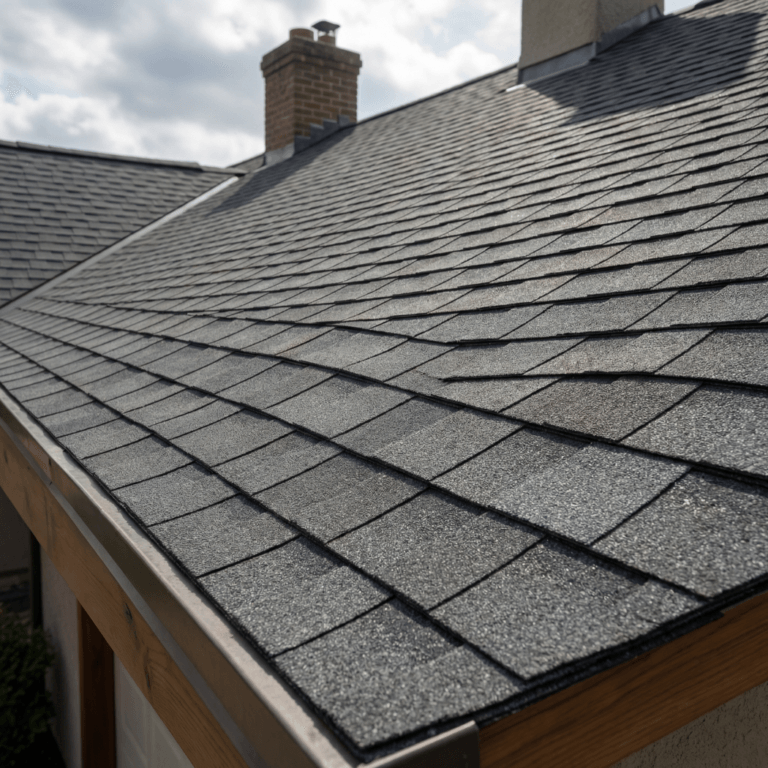
Gutters are a direct extension of that system. A roof with properly installed shingles, sealed underlayment, and quality drip edge still depends on functioning gutters to complete the water management chain. When the gutters fail, the performance of the shingles and underlayment above them is undermined by chronic moisture at the edge.
Owens Corning highlights complete system installation, including proper ventilation, underlayment, and edge components, as the standard for full warranty performance. Teague’s Platinum Preferred status with Owens Corning reflects that system approach across every installation.
When you are approaching a roof replacement, it makes sense to evaluate the gutters at the same time. Installing a new roof above failing gutters reduces the lifespan of the new roof before it is finished. Addressing both together ensures the full system is working as it was designed to work. Explore our full range of exterior services to see how we approach the whole exterior rather than individual components in isolation.
| Component | Role in the System | How It Helps in SW Missouri |
|---|---|---|
| Roof covering | First line of defense against rain, hail, and wind | Sheds water to the edge in every storm event |
| Underlayment | Secondary barrier under the shingles | Protects the deck if shingles are compromised |
| Sealed roof deck | Prevents water from reaching the interior even with surface damage | Critical in hail and high-wind events common in the region |
| Gutters | Catches water at the roof edge and channels it to downspouts | Prevents edge moisture, fascia rot, and overflow onto siding |
| Downspouts and extensions | Carries water to a safe discharge point away from the home | Protects foundation, grading, and basement from concentrated water |
Illustrative Drainage Scenarios Around Springfield
Illustrative scenario: A homeowner in Nixa noticed that water poured over the back gutters in nearly every significant spring rain. The front gutters seemed fine. Teague’s inspection found that the back gutters were a smaller profile than the front and that both outlets had partial blockages from accumulated debris. The solution was cleaning both outlets, adding a second outlet to the longest run, and upgrading the back gutters to a larger profile. The overflow stopped, and the soil along the back foundation dried out noticeably over the following month.
Illustrative scenario: A Republic homeowner noticed a persistent musty smell in one corner of the basement after spring storms but found no obvious interior water source. Teague walked the exterior and found that the downspout nearest that corner terminated six inches from the foundation wall with no extension, and that the soil had settled slightly toward the home in that area. Adding a rigid extension that moved the discharge point four feet from the wall, combined with a splash block and a minor grading correction, addressed the moisture source. The corner smell cleared within a few weeks.
Illustrative scenario: A Springfield homeowner scheduled a gutter replacement after noticing the gutters pulling away from the fascia in two locations. When Teague removed the old gutters for replacement, we found that the fascia boards behind them had rotted significantly in the sections where the gutters had been overflowing and separating for several seasons. We replaced the damaged fascia boards, installed new gutters with updated hangers and proper pitch, and extended the downspouts to discharge away from the foundation. The homeowner now has a system that functions correctly and fascia that will not need attention again for many years.
Frequently Asked Questions: Gutters, Downspouts, and Drainage in Springfield, MO
How often should I clean my gutters in Springfield?
At minimum, clean gutters twice a year, once in late spring after seed and pollen season and once in late fall after leaf drop. Homes with heavy tree cover may need three or four cleanings per year. In SW Missouri, clogged gutters during spring storm season are a significant risk because heavy rain events can overwhelm a partially blocked system quickly. A clean gutter going into storm season is one of the simplest things a homeowner can do to protect the full exterior.
Do I really need gutters on every side of my house?
In most cases, yes. Any roof slope that extends over a wall, doorway, or landscaping benefits from gutters. Slopes that dump water directly onto a paved surface away from the home may be lower priority, but any side where runoff reaches siding, a foundation wall, or a basement entry needs a gutter. Teague evaluates which slopes are most critical during any gutter inspection and recommends installation based on where water is causing or likely to cause problems.
How far should downspouts drain water away from my foundation?
At least four to six feet from the foundation wall, and farther is better if the lot allows it. The goal is to move water past the zone where it can saturate soil against the foundation. In SW Missouri, where clay soils are common and do not absorb water quickly, getting water several feet away from the home is especially important. Extensions are inexpensive and straightforward to add to any existing downspout.
What are the signs that my gutters are causing my roof leak?
Look for staining or soft spots on the fascia board directly behind the gutter, which suggests chronic moisture between the gutter and the wood. Check the underside of the roof edge for discoloration or soft decking at the eave. If a ceiling stain appears near an exterior wall rather than at the center of the roof, the source is often at the roof edge rather than further up the slope. A professional inspection that includes the gutter condition and the roof edge together usually identifies the connection quickly.
Can clogged gutters really damage my foundation or basement?
Yes. A clogged gutter that overflows drops water at the foundation wall repeatedly every time it rains. Over months and years, that concentrated water saturates the soil against the foundation, increases hydrostatic pressure against the wall, and can find its way into basement or crawlspace areas through cracks, joints, and porous masonry. The connection is direct and well-documented in building science research. Cleaning gutters and extending downspouts are among the lowest-cost steps a homeowner can take to protect the foundation.
What is the difference between gutter repair and full replacement?
Repair addresses specific failing components: re-fastening a section that pulled loose, re-sealing a leaking joint, clearing a blocked outlet, or patching a small rust hole. Replacement removes the entire gutter run and installs a new system with updated hangers, sealed joints, and correct pitch. Repair makes sense when the gutter is structurally sound but has isolated problems. Replacement makes sense when the gutter is old, rusted, deformed, or undersized for the roof it serves. Teague evaluates both options during a free inspection and recommends whichever actually solves the problem.
Should I replace my gutters when I replace my roof?
It is worth evaluating at the same time. Replacing a roof while leaving aging, undersized, or failing gutters in place means the new roof is working against a drainage system that cannot do its job. If your gutters are more than 20 years old, pulling away from the fascia, or consistently overflowing in heavy rain, replacing them alongside the roof is often more practical and cost-effective than doing two separate jobs. Teague reviews gutter condition as part of every roof replacement consultation.
Do I need gutter guards in Southwest Missouri?
Gutter guards reduce how often you need to clean gutters, but they do not eliminate maintenance entirely. In SW Missouri, where spring brings heavy seed and pollen loads and fall brings significant leaf fall from hardwood trees, guards reduce cleaning frequency meaningfully for many homeowners. They are worth considering for homes with heavy tree cover or for homeowners who have difficulty safely maintaining gutters. Teague can advise on whether guards make sense for your specific roof and tree situation during a gutter consultation.
What does a gutter inspection from Teague Roofing Plus include?
Our gutter inspection covers the full run of gutters on all sides of the home, checking for proper pitch, secure fastening, clean outlets and downspouts, intact joints and seams, and correct downspout termination points. We also look at the fascia condition behind the gutters, the drip edge at the roof edge above them, and the discharge areas at the base of each downspout. We walk you through the findings with photos and give you a clear recommendation on repair versus replacement before any work begins.
Key Takeaways for Springfield Homeowners
- Gutters are the first link in the drainage chain. When they fail, water reaches the fascia, siding, foundation, and basement in ways that accumulate over time.
- SW Missouri storms demand a functioning system. Heavy spring downpours and repeated thunderstorm events put real volume through your gutters. A partially failing system gets exposed quickly.
- Signs are visible if you look. Overflow during rain, sagging sections, siding stains, and foundation puddles all point to drainage problems that are worth addressing before they worsen.
- Extensions matter as much as gutters. A perfectly functioning gutter that drains at the foundation wall is still directing water to the wrong place. Extensions are simple and effective.
- Repair or replace based on what the system actually needs. Individual joint failures or sagging sections often repair well. Old, undersized, or extensively damaged systems usually perform better replaced.
- Gutters and roofs are connected. Replacing a roof without evaluating the gutters leaves the new roof working against a drainage system that may already be failing at the edge.
- A free inspection tells you where you stand. Whether the concern is overflow, basement moisture, or fascia damage, Teague will walk the property and give you a plain answer on what the gutter and drainage system actually needs.
Ready to Fix Your Gutters and Drainage the Right Way?
If you have seen water pouring over your gutters, noticed staining on your siding, or found puddles around your foundation after rain, those are signs worth taking seriously before they become bigger repairs. Teague Roofing Plus can walk your property, inspect the full drainage system from the gutters to the downspout discharge points, and give you a clear picture of what is working and what is not.
We have been protecting homes in Springfield, Nixa, Ozark, Republic, Willard, and across Southwest Missouri since 1971. Gutters, downspouts, and drainage are part of the same exterior system as the roof, and we address them together so the fix is complete rather than partial. Josh and the team will show you photos of what they find, explain your options in plain language, and tell you honestly whether a repair or a replacement makes more sense.
Call 417-883-7663 or contact us online to schedule your free inspection. We also handle emergency roof repair if storm damage has already reached the point where water is entering your home.
Teague Roofing Plus | Roofing, Siding, Windows, Gutters, and More. Serving Southwest Missouri Since 1971.