
Every significant storm in Southwest Missouri leaves some homeowners looking at their siding and wondering whether what they see is cosmetic or something worse. Cracks, chips, and dents from hail are easy to spot. The damage behind them, water working into wall cavities through gaps and splits, is harder to see until it has been going on a while. This guide explains how hail and wind damage siding, what the warning signs look like, and how Teague Roofing Plus helps Springfield-area homeowners decide between targeted repair and full replacement.
TLDR: Hail and wind storm damage to siding in Southwest Missouri can range from a few cracked panels to widespread failure across the full exterior. Localized damage on a sound, relatively young siding system usually points toward repair. Widespread damage, old or brittle material, or evidence of moisture behind the siding usually points toward replacement. A free inspection from Teague Roofing Plus gives you a clear answer before water damage gets any further.
You notice dents and cracks in your siding every time you pull into the driveway. Maybe the damage showed up after last week’s hail, or maybe it has been building up gradually through a few seasons of storms. Either way, you are not sure if a few panels need swapping out or if this is a bigger project.
What you probably worry about more than the visible damage is what water is doing behind it where you cannot see. A crack in vinyl siding or a chip in fiber cement does not have to be large to let wind-driven rain into the wall cavity. Once water reaches the sheathing and framing behind the siding, the damage that develops is invisible until it is significant.
This guide gives you the information you need to assess what you are dealing with and understand when repair is the right call and when replacement makes more sense for your home.
How Hail and Wind Actually Damage Siding
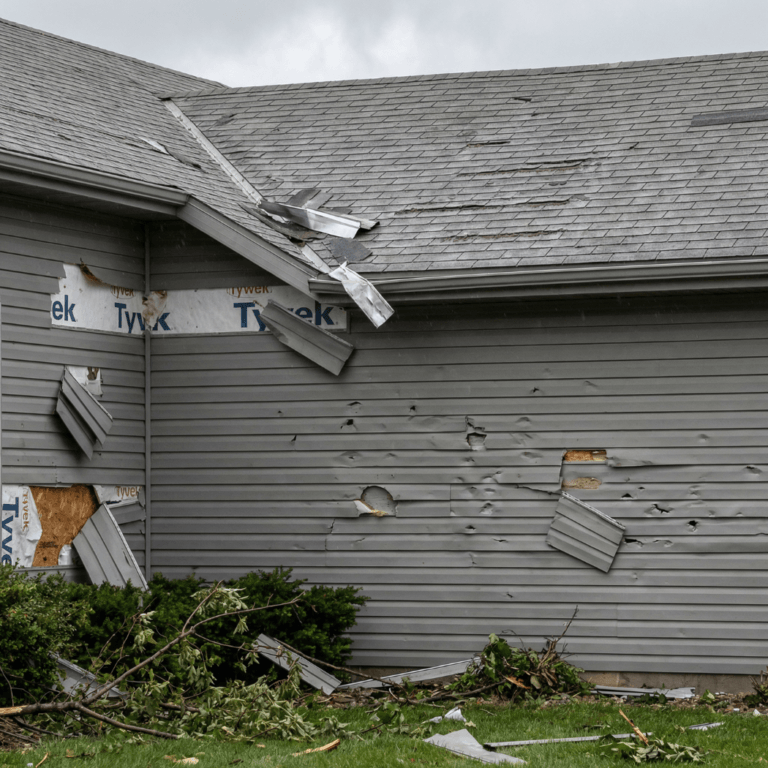
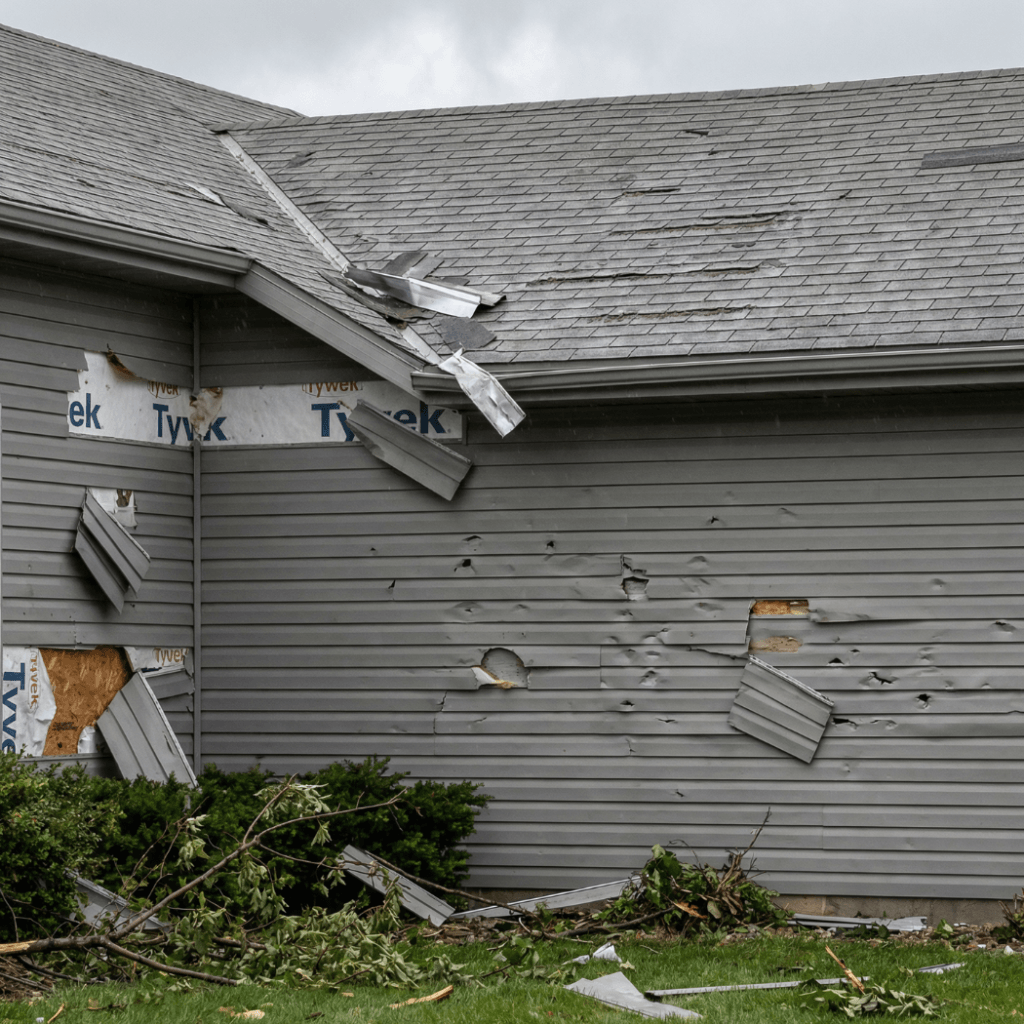
Hail damage to siding follows a similar pattern to hail damage on a roof: random impact marks concentrated on the faces that were most exposed to the storm’s direction. On vinyl siding, hail cracks the material along its surface, sometimes splitting panels or knocking chips out of corners. On fiber cement, hail can chip the paint and finish coat, creating entry points for moisture even when the panel itself stays intact. On older wood or engineered wood siding, hail strips paint and raises the grain, accelerating the aging process.
Wind does different work. High-speed gusts drive debris into siding surfaces, creating impact holes that can be small but go completely through the panel. Wind also finds gaps, loose trim, and improperly fastened sections and either pulls them away from the wall or pries open joints that were previously sealed. Once a joint opens or a panel lifts, sideways rain during the same storm enters the wall immediately.
According to IBHS wind research, high winds damage exterior cladding through both direct impact and pressure changes that force water into small openings. Southwest Missouri storms regularly combine hail, strong wind, and heavy rain in the same event, which means siding faces multiple simultaneous stresses. IBHS natural weathering and hazard exposure research confirms that cumulative exposure to repeated moderate events often produces as much long-term damage as a single severe storm.
According to NWS Springfield, the region sees repeated severe thunderstorm activity with hail and damaging winds, particularly in spring and early summer. Homes in Republic, Willard, Battlefield, and surrounding communities face this weather pattern regularly throughout a siding system’s lifespan.
| Siding Type | Common Hail Damage | Common Wind Damage |
|---|---|---|
| Vinyl | Cracks, splits, and brittle fractures at impact points | Panels pulled loose at joints or ends; trim separation |
| Fiber cement | Paint and finish chipping at impact points; surface penetration in larger hail | Less prone to wind-driven loosening if properly fastened |
| Engineered wood | Paint stripping, grain raising, surface splitting at impact | Edge separation if paint or caulk maintenance was deferred |
| Traditional wood | Paint loss, grain damage, surface checking | Fastener pull-through on older installations; end grain moisture entry |
Siding Damage Checklist After a Storm
After any storm that brought significant hail or high winds, a slow walk around the full perimeter of your home gives you most of the information you need to decide whether to call for an inspection.
Look at each wall from the ground. Cracks or splits in vinyl panels are often visible without getting close. Fiber cement damage may be subtler, showing up as small chips or bare spots where the paint finish lifted. Look for pieces of siding, trim, or soffit on the ground or in the yard. Any material that left the wall is evidence of the storm’s force and a clear sign that an opening exists somewhere.
Check the trim around every window and door for gaps, cracks, or separation. These joints are sealed with caulk that ages over time, and storm impacts or wind pressure often opens them. Look at corners and along the roofline for any sections that appear to have shifted, bowed, or pulled away from the wall surface. Warped or bowed panels indicate moisture is already affecting the material.
Take photos and short video of anything you find, noting the date and connecting the observations to the specific storm if possible. That documentation supports an insurance claim if you decide to file one.
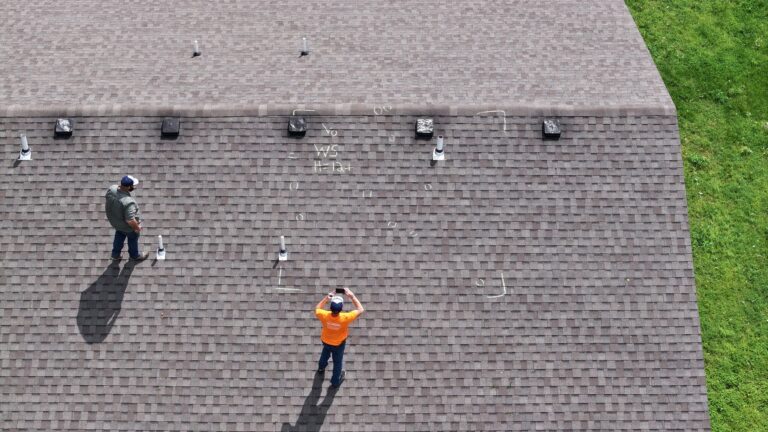
Our storm damage repair team assesses siding alongside roofing and gutters, since all three are typically affected in the same storm event. Our free inspection covers the full exterior envelope, not just the roof.
| Sign | What It Might Mean | How Soon to Call |
|---|---|---|
| Hairline cracks in individual panels | Impact damage; may be surface only or may go through | Within a week; check for moisture behind the crack |
| Holes through the panel | Active opening for water entry | Call promptly; water is likely already entering |
| Missing panels or trim sections | Exposed sheathing or framing | Call immediately; emergency repair may be needed |
| Loose or rattling trim | Joint failure or fastener pull; water entry likely at the edge | Call within a week |
| Round impact marks matching hail pattern | Hail confirmed; check for functional damage beyond surface | Schedule inspection; document for potential insurance claim |
When Siding Repair Is Usually Enough
Not every storm leaves behind a full replacement job. Siding repair makes good sense when the damage is limited in scope and the rest of the system is in sound condition.
A few cracked vinyl panels on one wall of an otherwise intact house is a straightforward repair scenario. If the panels behind the cracks are dry, the sheathing is solid, and matching material is available, replacing those sections is practical and effective. The same logic applies to trim pieces that blew loose but did not break significantly, small impact chips on fiber cement that have not penetrated through the paint to exposed substrate, or sections of soffit that came down but can be re-secured without replacing the full run.
The key qualifier is what Teague finds behind the damaged panels. If the sheathing and framing are dry and intact, a repair locks out future moisture and extends the life of the existing system. If there is already softness or staining behind the panels, the repair has to address that too, which changes the scope.
Our siding repair team handles panel replacement, trim repair, and re-caulking throughout the Springfield area and surrounding communities, including Nixa, Ozark, and Rogersville.
| Problem | Typical Scope | Why Repair Works |
|---|---|---|
| A few cracked vinyl panels on one wall | Replace individual panels; check sheathing | Rest of system intact; isolated damage with a clear fix |
| Loose trim in one area after wind | Re-secure and re-seal trim; check for water entry | Fasteners pulled but structure is sound |
| Minor hail chipping on small sections of fiber cement | Re-paint affected areas; seal any penetrating chips | Damage is surface-level; no structural compromise |
When Siding Replacement Is the Smarter Move
At some point, the math on repairs stops working. That point usually arrives when damage is widespread, when the siding material is old and brittle, or when the inspection reveals moisture damage behind the panels that extends beyond what a targeted repair can address.
When hail and wind damage covers multiple walls of the home, patching the affected sections often produces a visibly mismatched result because aged and weathered siding rarely matches new material exactly. Beyond appearance, patching a siding system that has reached the end of its functional life means the next storm finds new weak points on the sections that were not replaced.
Old vinyl that has become brittle with UV exposure breaks differently than new material and cannot be reliably repaired to hold against future impacts. Siding that has been patched multiple times over the years, or that has visible rot or soft spots at corners and lower courses, is telling you that the water it has already absorbed has compromised the substrate behind it. In those situations, full replacement lets Teague address the underlying condition, install new weather-resistant barrier material, and put up a siding system that performs correctly from the wall in.
Homeowners in Fair Grove, Marshfield, Aurora, and Branson who are considering siding upgrades alongside storm repairs often find that replacing aging material with James Hardie fiber cement siding provides significantly better storm resistance and long-term durability compared to patching worn vinyl or engineered wood. James Hardie products are tested for hail impact and wind-driven rain resistance and are designed specifically for the kind of climate variation SW Missouri produces.
| Situation | Why Repairs Struggle | Why Replacement Helps |
|---|---|---|
| Widespread hail damage across multiple walls | Patched areas do not match; remaining panels are equally compromised | Full replacement creates uniform protection across the exterior |
| Old or brittle panels fading and cracking broadly | Brittle material does not hold repairs reliably | New material performs correctly and matches throughout |
| Hidden rot or soft spots behind damaged sections | Repair at the surface does not address the substrate condition | Replacement allows full inspection and repair of the underlying wall |
| Multiple past patches already on the system | Accumulated repairs create inconsistent performance | Replacement clears the history and resets the system |
Our full range of exterior services includes siding replacement with vinyl, fiber cement, and engineered wood options selected to match the home, the neighborhood, and the storm history of the area.
How Siding Problems Connect to Roof, Gutters, and Windows
Siding damage rarely stays isolated. The exterior of a home works as a connected system, and failures in one component often show up as symptoms in another.
IBHS water intrusion research identifies multiple pathways for water to reach wall cavities, and damaged siding is one of the primary ones. When wind-driven rain enters through a cracked panel or failed caulk joint during a storm, it typically does not stop at the sheathing. It runs down inside the wall assembly, finding insulation, framing, and eventually ceilings or floors where it becomes visible.
Along the roofline, eave overhang and drip edge condition directly affect how much water contacts the upper course of siding. A roof edge that is failing or gutters that overflow send water onto the siding surface repeatedly, which accelerates paint failure and can cause upper course warping even on siding that took no direct storm damage.
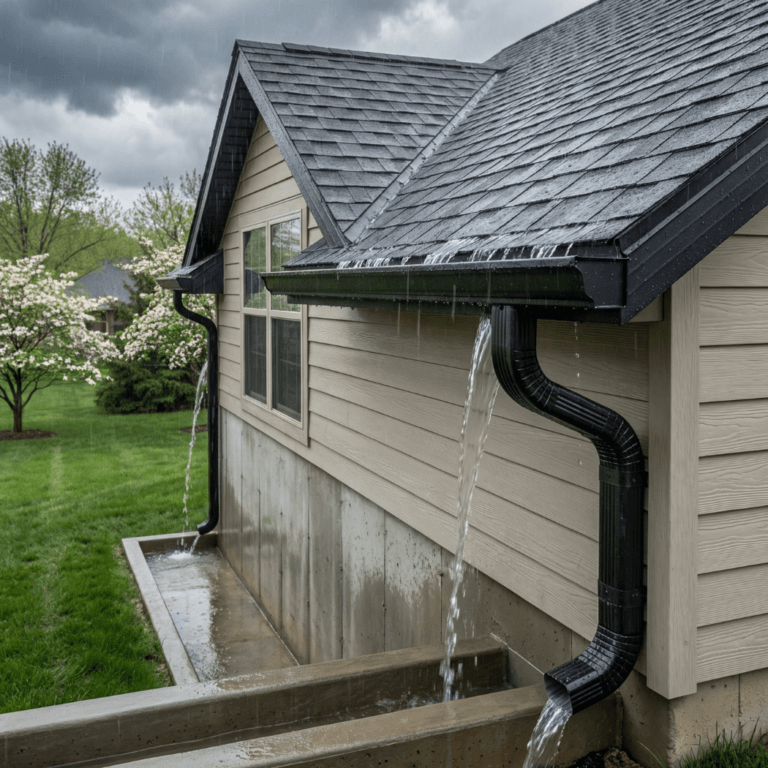
At the foundation, gutters and downspouts that discharge too close to the home soak lower siding courses from below. Lower panels that stay wet through repeated storms develop moisture-related failure earlier than the rest of the system, and the damage often looks like a siding problem when the actual source is gutter drainage.
Teague evaluates the full exterior envelope during any siding inspection. Our roof repair services and gutter repair teams are part of the same operation, so when a siding inspection reveals connected issues, we address them together rather than leaving one component failing while another gets repaired.
| Visible Problem | Likely Related System | Recommended Check |
|---|---|---|
| Staining or warping along upper siding courses near the roofline | Roof edge condition, drip edge, and gutter overflow | Inspect roof edge and gutter attachment simultaneously |
| Warped or soft lower panels near the foundation | Downspout discharge location and gutter overflow | Check downspout extensions and grading at foundation |
| Rot or moisture at siding corners | Caulk failure, trim joint gaps, and water collecting at corners | Inspect all trim joints, window corners, and penetration seals |
| Paint peeling near gutter lines | Chronic water contact from overflowing or leaking gutters | Inspect gutter fastening, pitch, and joint condition |
Siding Materials and Storm Performance in Southwest Missouri
Choosing a siding material when repairing or replacing after storm damage is partly a decision about future performance in the specific climate your home faces.
Vinyl siding is the most common exterior material in Springfield, Nixa, and surrounding communities. It is lightweight, requires minimal maintenance, and comes in a wide range of colors and profiles. In terms of storm performance, vinyl can crack from hail impact and becomes more brittle with UV exposure over time. Hail resistance varies significantly by product thickness and profile. In SW Missouri’s hail zone, thinner vinyl can show widespread cracking after significant events.
Fiber cement siding, most commonly associated with James Hardie products, is heavier and more impact-resistant than vinyl. Its cement-based composition resists cracking from hail and does not become brittle with UV exposure the way vinyl can. It also resists moisture absorption that would otherwise cause swelling and rot. The tradeoff is higher material weight, which requires appropriate fastening and installation practices. When properly installed, fiber cement handles repeated SW Missouri hail events better than most alternative materials.
Engineered wood siding, including products like LP SmartSide, offers improved moisture resistance compared to traditional wood while maintaining a wood-grain appearance. It is more impact-resilient than standard wood and holds paint well when the finish is maintained. In the wet springs that SW Missouri regularly sees, maintenance of paint and caulk around trim and joints is more important with engineered wood than with fiber cement.
As an established Springfield roofing company and siding contractor, Teague helps homeowners choose materials that match their home, their neighborhood aesthetic, and the storm history of their specific location in SW Missouri.
| Siding Type | Hail Resistance | Wind Resistance | Maintenance Needs |
|---|---|---|---|
| Vinyl | Lower to moderate depending on thickness; can crack in large hail | Good if properly fastened; loses flexibility with age | Low; clean periodically, inspect caulk |
| Fiber cement | Higher; resists cracking and impact penetration | Excellent when properly fastened | Moderate; requires paint maintenance every several years |
| Engineered wood | Moderate; better than traditional wood | Good with proper installation | Moderate to higher; paint and caulk maintenance important |
| Traditional wood | Lower; splits and checks under hail and moisture | Moderate; fastener quality matters | Higher; paint, caulk, and periodic sealing required |
Insurance, Siding Claims, and Documentation
When hail or wind damages your siding, that damage is often part of the same storm event that affected your roof and gutters. Many homeowners file a single claim that covers all three components, which is why documentation matters across the entire exterior, not just the roof.
Photograph every wall immediately after the storm, before anything is moved or cleaned. Note the direction the storm came from if you know it, since insurance adjusters look for damage patterns that match storm direction. Document any material you find on the ground as evidence of the storm’s force. If the damage is significant across multiple walls, the claim may support full replacement rather than targeted repairs, which depends on your policy type and the documented scope.
Missouri homeowners with questions about how their policy handles siding damage, or who want guidance on what their insurer is required to cover, can contact the Missouri Department of Commerce and Insurance for plain-language consumer guidance.
Teague documents siding condition as part of any storm damage inspection, prepares written scopes of repair or replacement, and can meet your adjuster on site to walk through the findings. Our insurance claim assistance service covers the full exterior claim process at no additional charge to the homeowner.
| Step | Why It Matters | What to Save |
|---|---|---|
| Photograph all walls immediately after the storm | Creates a pre-repair baseline that matches the storm event | Store with date and time stamps |
| Call for a professional siding and exterior inspection | Documents damage professionally for both repair planning and insurer review | Keep the written inspection report |
| File claim if damage meets your deductible threshold | Covers repair or replacement costs for covered storm events | Save the claim number and adjuster contact |
| Keep estimates and invoices for all work done | Required for depreciation release on RCV policies and for future reference | File with insurance documents |
Illustrative Siding Scenarios from Around Springfield
Illustrative scenario: A homeowner in Nixa had the west wall of their home take the brunt of a late-spring hail event. The east and north sides showed minimal damage, but the west wall had cracked panels in three sections totaling about a dozen pieces. Teague’s inspection found dry sheathing behind the cracks and confirmed the rest of the siding system was in good condition. The team replaced the cracked panels with well-matched material, re-caulked the trim joints on the affected wall, and confirmed no moisture had reached the sheathing. The repair was complete in a day and the wall was fully protected again.
Illustrative scenario: After a significant hail and wind event moved through Republic, a homeowner found cracks and splits across nearly every wall. The siding was already roughly 20 years old, visibly faded and showing early brittleness along the bottom courses. Teague’s inspection found damage on all four sides and confirmed the material was at the end of its practical life. Patching individual sections across the full perimeter would have produced a heavily mismatched result and left the remaining brittle panels vulnerable to the next storm. Teague recommended full replacement with fiber cement siding. The homeowner filed a claim with the inspection documentation, and the insurer approved replacement.
Illustrative scenario: A homeowner in Springfield noticed warped lower panels along the back wall and paint peeling along the foundation course. No recent storm seemed to explain it. Teague found that a downspout on the back corner discharged directly at the foundation wall with no extension, and that the gutter above it had a joint leak directing water down the wall surface for at least two seasons. The lower siding had absorbed chronic moisture over that period. Teague replaced the damaged lower panels, corrected the gutter joint, added a downspout extension, and confirmed the sheathing was damp but not yet rotted. Addressing the source and the symptom together stopped the problem from continuing.
Frequently Asked Questions: Siding Damage, Repair, and Replacement in Springfield, MO
How do I know if my siding has hail damage?
Look for impact marks in a random but directionally consistent pattern across the walls that faced the storm. On vinyl, these often appear as cracks or fracture lines radiating from a central impact point. On fiber cement, look for chips or bare spots where the paint and finish layer lifted. On engineered wood, look for dents that disrupted the surface and any areas where moisture has already begun to swell the material. Dents on your gutters, A/C unit, and vehicles from the same event confirm hail reached the property at significant force.
Can I just replace a few damaged siding panels, or do I need new siding on the whole house?
In many cases, replacing a few panels is the right answer. Localized damage on a sound, relatively young siding system repairs well when the material behind the panels is dry and the rest of the system is in good condition. The practical limit is matching: older siding fades over time, and replacement panels rarely match exactly. If the damage is limited to a small area and you can accept a slight color variation, repair is usually practical. If damage is widespread or the overall system is aging and brittle, replacement produces a more reliable and better-looking result.
What siding types hold up best to hail and wind in Southwest Missouri?
Fiber cement siding holds up better to hail impact than vinyl and does not become brittle with UV exposure over time. It is heavier and more expensive to install, but its performance in repeated storm events is consistently better in SW Missouri’s hail zone. Thicker vinyl profiles perform better than thin ones, but all vinyl can crack from significant hail impact. Engineered wood performs reasonably well when installation and paint maintenance are kept up. For homeowners replacing siding after storm damage, fiber cement is worth serious consideration if the budget allows it.
Does faded or warped siding always mean I need replacement?
Fading alone does not mean replacement is necessary, though it signals that the material is aging and may have reduced flexibility. Warping is a more significant sign because it typically indicates moisture has entered the material or the area behind it. Panels that have swelled, bowed, or pulled away from the wall usually cannot be effectively straightened and sealed. The key question is whether the warped area is isolated or part of a broader pattern. A professional inspection determines which situation you are dealing with before any commitment is made.
How does siding damage affect my home’s insulation and interior walls?
Siding that has cracked or separated creates entry points for wind-driven rain to reach the wall cavity. Water in the wall cavity soaks the insulation, reducing its effectiveness and creating the humid conditions that support mold growth. From the insulation, moisture can reach framing, which softens over time and loses structural integrity. By the time interior wall staining becomes visible, water has typically been active in the wall cavity for weeks or longer. Catching and repairing siding damage promptly limits how far that water gets.
Will my homeowners insurance cover siding damage from storms?
Most standard homeowners policies cover siding damage from hail and wind as part of a covered storm event. Coverage depends on your specific policy type, your deductible, the age of the siding, and how the damage is documented. Policies that pay Replacement Cost Value cover full replacement at current rates minus the deductible. Policies that pay Actual Cash Value deduct for depreciation, which can significantly reduce the payment on older siding. Missouri homeowners with questions about their coverage can contact the Missouri DCI at insurance.mo.gov for guidance on what their policy requires.
How long does siding repair usually take compared to full replacement?
A targeted repair covering a wall section or a few panels typically takes one day or less. Re-caulking trim and joints adds a few hours. Full siding replacement on a standard home in Springfield typically takes two to four days depending on the size of the home, the number of stories, and the material being installed. Fiber cement takes somewhat longer to install than vinyl due to its weight and fastening requirements. Teague provides a timeline estimate as part of every inspection and proposal.
What does a siding inspection from Teague Roofing Plus include?
A Teague siding inspection covers all exterior walls of the home from the ground, checking for impact damage, cracks, loose sections, trim separation, and caulk failures. We check the condition visible behind any panels that have already separated or cracked and look at the roofline, gutters, and downspout discharge points that affect siding moisture conditions. We take photos and walk you through the findings before recommending repair or replacement. There is no charge for the inspection and no obligation attached to the conversation.
Key Takeaways for Springfield Homeowners
- Storm damage to siding is often more than cosmetic. Cracks and chips open pathways for wind-driven rain to reach wall cavities, insulation, and framing behind the panels.
- Check all four sides after any significant storm. Hail and wind damage concentrates on the faces that faced the storm, but sideways rain and debris reach more of the exterior than most homeowners expect.
- Repair works when the damage is limited and the underlying system is sound. Dry sheathing, intact framing, and matched material are the conditions that make targeted siding repair a practical choice.
- Replacement is the more reliable solution when damage is widespread or the material is aging. Patching a failing system delays the problem without solving it.
- Siding, gutters, and roofing are connected. Gutter overflow and roof edge failures often cause siding damage that looks unrelated. Addressing one without the other leaves the new repair exposed to the same source.
- Document everything immediately. Photos dated to the storm event are the foundation of any insurance claim for storm damage.
- A free inspection answers the repair-or-replace question before you commit to anything. Teague walks the full exterior, shows you the findings, and gives you a straight recommendation.
Want an Honest Look at Your Siding After a Storm?
If you have seen cracks, dents, or gaps in your siding after a recent storm, or if something has been bothering you about how the exterior looks and you are not sure what it means, a free exterior inspection from Teague Roofing Plus is the right starting point. We walk the full perimeter, show you photos of what we find, and give you a clear answer on whether repair or replacement fits your home and your situation.
Teague has been protecting homes in Springfield, Nixa, Ozark, Republic, Strafford, and communities across Southwest Missouri since 1971. We have seen what hail and wind events do to every type of siding in this climate, and we give the same recommendation we would give our own family: what the inspection actually supports, not what generates the largest job.
Call 417-883-7663 or contact us online to schedule your free inspection. If storm damage reaches beyond the siding into the roof or gutters, our roof replacement and gutter installation teams handle the full exterior in one coordinated project.
Teague Roofing Plus | Roofing, Siding, Windows, Gutters, and More. Serving Southwest Missouri Since 1971.