
Choosing a new roof color is one of the decisions homeowners stress about most during a replacement project. The roof covers a significant part of what your neighbors and anyone passing by will see, and whatever you pick stays on the home for the next 25 to 30 years. This guide gives you a practical framework for choosing a shingle color that works with your home’s style, fits your neighborhood, holds up to SW Missouri’s climate, and is something you will still appreciate a decade from now.
TLDR: Start with your home’s existing exterior colors, not the shingle board. Match or contrast undertones intentionally. Neutral colors like charcoal, medium gray, and brown blends work well across most Springfield neighborhoods and hold up visually over time. Check HOA requirements before finalizing any choice. Teague Roofing Plus can bring samples to your home and help you narrow the options based on what actually works with your siding, brick, and trim.
Picking a roof color should not feel like a stressful design project, but for most homeowners it does. You stand in front of a shingle board at the supply house, or you flip through a sample book, and every color looks almost the same inside or seems impossible to picture on the actual house.
The better approach is to start from the outside in. Look at your home first: the siding color, the brick, the trim, the stone or wood accents. Your house already tells you a lot about what will work on top of it. A shingle color is most successful when it feels like it belongs to the home rather than competing with it.
This guide walks you through the practical framework Teague Roofing Plus uses with Springfield-area homeowners every day: start with your existing exterior, understand your color options, consider the neighborhood context, and then use the right tools to see the result before you commit.
Why Roof Color Feels Like a Big Deal
The roof is one of the most visually prominent parts of your home. On a typical house, the roof represents a significant portion of what someone sees from the street, especially on one-story homes where the roof pitch is steep and visible from almost every angle. Getting it wrong does not just feel uncomfortable to you. It shows.
Springfield roofs also have to perform. Hail, high winds, and summer heat put real stress on the materials above your head, which means you need to care about both appearance and function when you choose a new roof. The good news is that these do not have to be competing priorities. Owens Corning’s roof color guide notes that most homeowners feel overwhelmed by color choices but find the process much more manageable once they understand a few basic principles.
Teague has guided thousands of local homeowners in Springfield, Nixa, Ozark, Republic, and the surrounding area through this exact decision. The right choice is almost always clearer once you look at the home itself rather than a sample board in isolation.
| Worry | Why It Matters |
|---|---|
| Picking the “wrong” color | The roof stays for 25 to 30 years, so the stakes feel high |
| Standing out too much | Most homeowners want their roof to complement the home, not compete with it |
| Matching siding and brick | The wrong color pairing undermines curb appeal even on a quality roof |
| HOA concerns | Some neighborhoods restrict color choices; picking first can mean starting over |
Start with Your Home’s Style and Exterior Colors
Before you look at a single shingle, go outside and spend a few minutes looking at your home the way a visitor would see it. Note the main siding color and whether it leans warm or cool. Warm siding has undertones of tan, yellow, orange, or red. Cool siding has undertones of gray, blue, or green. Note the trim and window frame colors, and any accent elements like stone, brick, or wood.
The most important general rule in roof color selection is intentional contrast. A home with light-colored siding looks best with a darker roof because the contrast creates visual definition between the walls and the roofline. A home with darker siding benefits from a medium-value roof that complements without disappearing into the walls. Very light siding with a very light roof tends to look washed out. Very dark siding with a very dark roof can lose definition in the same way.
Matching undertones is equally important. A roof with warm brown and tan tones looks right on a home with warm brick or beige siding. A roof in cool gray or charcoal looks right on a home with gray, blue-gray, or white siding. When undertones clash, the roof feels out of place even if the color itself is not wrong.
A roof replacement consultation with Teague starts with this exterior assessment so we can help you narrow the options based on what your home actually has, not what looks good in a catalog. As an established Springfield roofing company since 1971, our team has matched roof colors to nearly every style of home in the region.
| Home Style and Exterior | Roof Color Direction |
|---|---|
| Light gray siding with white trim | Charcoal, dark gray, or slate for contrast |
| Red or warm brick | Brown, weathered wood, or medium gray for complementary tones |
| Tan or beige siding | Brown blends, soft black, or warm gray for contrast |
| White farmhouse with black accents | Charcoal or deep gray for a classic, high-contrast look |
| Dark gray or navy siding | Medium gray or warm brown to complement without disappearing |
Popular Roof Colors in Springfield and Southwest Missouri
Across Springfield, Willard, Battlefield, and Strafford, the most common new roof colors fall into the neutral family: charcoals, medium and light grays, and warm brown blends. This is not a coincidence. Neutrals work with almost any siding color, they age well as exterior trends change, and they tend to satisfy HOA requirements with minimal friction.
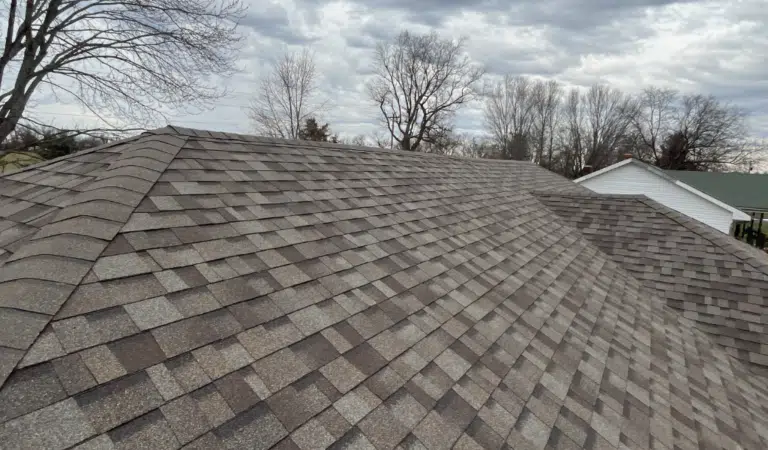
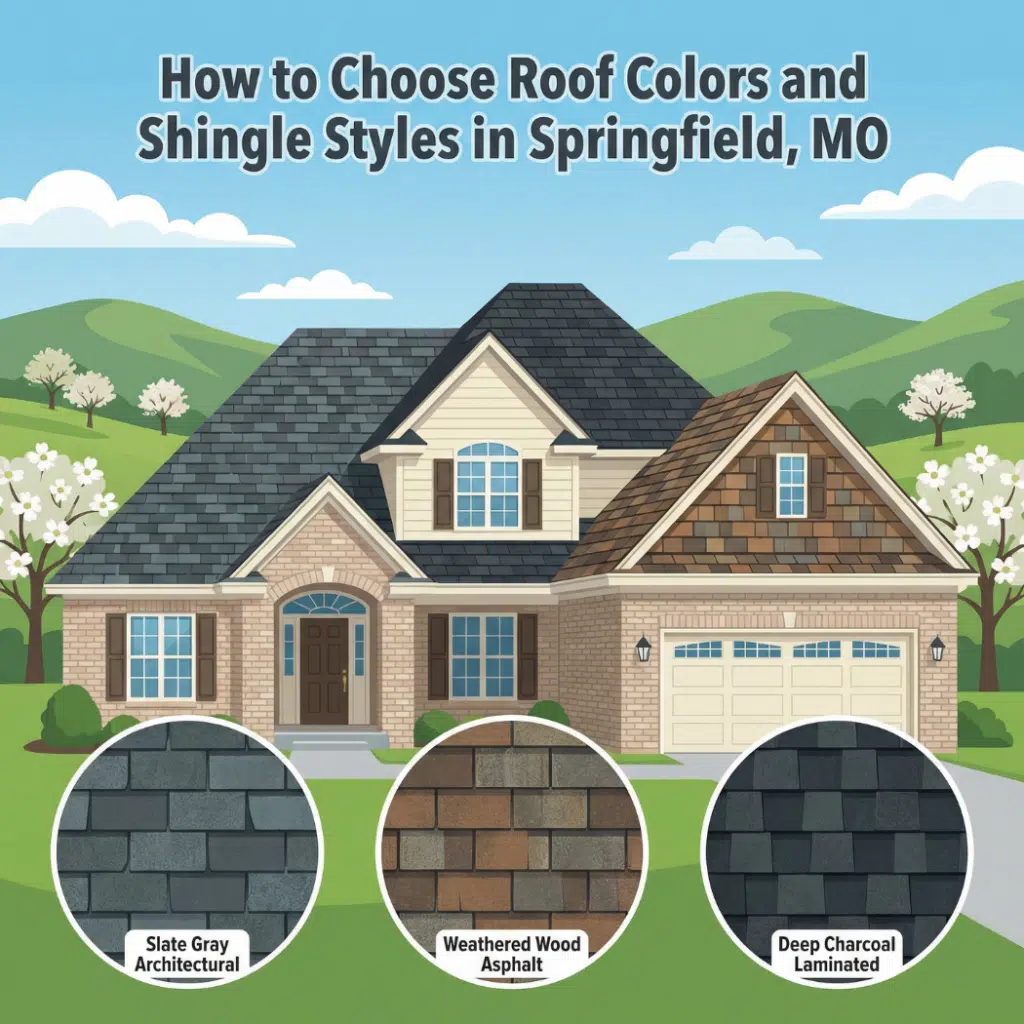
Charcoal and near-black shingles are consistently among the most popular choices in the region. They create strong contrast against lighter-colored homes, they show very little variation from curb appeal as they age, and they are a safe choice for resale. Medium gray shingles offer a slightly softer look while still providing contrast against most siding colors. Brown and tan blends work particularly well on homes with warm brick, wood accents, or earth-tone siding.
Multi-tone or “designer blend” shingles have grown significantly in popularity over the past decade. These shingles incorporate two or more color tones in each shingle, creating a dimensional appearance on the roof surface that adds depth and visual interest. A charcoal blend, for example, might include tones of dark gray, light gray, and black in a single shingle, which creates a more natural, varied look than a single-color product.
Our siding repair and exterior services also give us a view of how the full exterior works together. If you are considering a siding color change alongside or after your roof, that conversation is worth having before you finalize the roof color. Our full range of exterior services covers the complete exterior so decisions on each component can support rather than work against each other.
| Color Family | Works Well With | Overall Look |
|---|---|---|
| Black and charcoal | White, light gray, and cream siding | Bold, defined, classic contrast |
| Medium gray | Gray, blue-gray, and off-white siding | Clean, modern, works across many home styles |
| Light gray | White and very light siding | Soft, cohesive look; low contrast |
| Brown and tan blends | Brick, warm beige, and earth-tone siding | Warm, traditional, natural-feeling |
How Roof Color Affects Curb Appeal, Heat, and Maintenance
Beyond looks, homeowners sometimes ask whether roof color affects how hot the house gets or how much maintenance the roof requires. The answers are nuanced enough to be worth addressing directly.
On curb appeal, the roof either supports the home’s design or competes with it. A well-chosen neutral lets the architectural details of the home, the windows, the trim, the stone or brick, read clearly from the street. A poorly chosen color draws attention to itself and away from the home’s best features. This is why most design guidance points toward colors that complement rather than dominate.
On heat, lighter-colored shingles do reflect more solar energy than very dark ones under direct sunlight. However, attic ventilation and insulation drive most of the comfort and energy performance in a home, not shingle color alone. A dark roof over a well-ventilated, well-insulated attic performs very differently from the same dark roof over an attic with blocked soffit vents and thin insulation. Color makes a contribution, but it is not the primary lever for home comfort.
On maintenance, darker roofs tend to hide mild surface discoloration, minor algae streaking, and normal weathering better than very light roofs. Light-colored roofs can show dirt and algae more clearly, which may mean more visible maintenance between cleanings. This is a minor consideration for most homeowners but worth noting if your home is under significant tree cover or in an area with high moisture.
| Factor | Lighter Colors | Darker Colors |
|---|---|---|
| Visual feel | Softer, less contrast; can feel understated | Stronger contrast; more dramatic and defined |
| Dirt and algae visibility | Shows more clearly; may require more frequent cleaning | Shows less; minor weathering less visible |
| Perceived heat impact | Reflects slightly more solar energy | Absorbs slightly more solar energy at the surface |
| Design impact | Quieter, tends to recede | More prominent; stronger curb appeal statement |
HOA and Neighborhood Considerations
If your home falls under a homeowners association, checking the rules before you choose a color is not optional. Many HOAs in Springfield, Rogersville, and communities across SW Missouri have roof color guidelines in their covenants. These guidelines typically exist to keep a cohesive neighborhood appearance and protect property values, and they often list approved color families or specific product requirements.
The process is straightforward. Review your HOA documents or contact the management company before you finalize a shingle color. Look at the roofs on approved homes in your neighborhood to understand the practical range of what has been accepted. If the HOA requires written approval, submit your color choice and product information before signing a contract with a roofing company. Getting approval in writing protects you if questions arise later.
Teague can provide color samples, shingle samples, and manufacturer product data in whatever format your HOA board requires for an approval request. We have worked through this process with homeowners across Springfield-area neighborhoods and know what documentation typically satisfies HOA review.
| Step | What to Do | Why It Helps |
|---|---|---|
| Read HOA documents | Find the roof color section in your CC&Rs | Understand what is allowed before you fall in love with a color |
| Look at neighborhood roofs | Note what existing approved homes are using | Understand the practical color range your HOA accepts |
| Get approval in writing | Submit product info and color choice to HOA board | Protects you if questions come up after installation |
| Save all documents | Keep approvals, product data, and correspondence | Reference if you sell the home or if the HOA asks later |
As a locally established Springfield roofing company, Teague knows which neighborhoods have HOA requirements and can help you navigate the approval process as part of your project.
Using Owens Corning Tools and Teague’s Experience to See Colors Before You Commit
One of the most effective ways to reduce color decision stress is to see the color on a house that looks like yours before you commit. Owens Corning offers two online tools specifically for this: the Design Inspire gallery and the DesignEyeQ visualizer.
Design Inspire shows a library of homes with different shingle colors applied, organized by home style and color family. It is useful for getting a feel for how different color families look on homes similar to yours. DesignEyeQ allows you to upload a photo of your own home and apply shingle colors directly to it, which gives you a much more realistic preview than looking at a sample board.
These tools work best as a starting point. Digital visualization is helpful, but it does not fully replicate standing in front of your home and holding a physical sample against the actual siding and brick in natural light. Teague can bring shingle boards and sample pieces to your home during a consultation, which lets you see the color against your specific exterior in your specific light conditions. We can also share before-and-after photos from past projects in Springfield and nearby communities to give you a sense of how particular colors translate to completed homes.
| Tool or Help | What It Does | How Teague Uses It with You |
|---|---|---|
| Owens Corning online visualizer | Shows shingle colors on sample homes or your uploaded photo | Starting point for narrowing color families before the in-person visit |
| Physical sample boards | Full shingle samples in actual material | Held against your siding and brick in natural light during the consultation |
| Local project photos | Before-and-after images from completed Springfield-area homes | Shows how specific colors translate to real homes in the region |
Our roof replacement consultations always include a color review at the home. You are making a decision that will be on your house for decades, and seeing real samples in real conditions is part of making that decision confidently.
Thinking About Impact-Resistant Shingles and Performance, Not Just Color
In SW Missouri’s hail environment, some homeowners approach the material decision the other way: they choose the shingle line based on performance first and then select their preferred color within that line.
IBHS impact-resistant shingle ratings evaluate how shingles handle hail impacts at different sizes and speeds, not how they look. Class 4 is the highest rating, designed to resist the kind of large hail that SW Missouri sees repeatedly over a roof’s lifespan. When homeowners in Republic, Fair Grove, and Marshfield ask about impact resistance, the answer starts with which shingle lines earn that rating and then moves to which colors are available within those lines.
Owens Corning’s Roofing 101 guide for homeowners covers how to evaluate shingle systems across both performance and aesthetic criteria. The practical result for most homeowners is that the full range of popular neutral colors, charcoals, grays, and brown blends, is available within impact-rated product lines. Choosing performance does not mean settling for a color you do not like.
Our storm damage repair team sees firsthand what happens to different shingle products after significant hail events. That experience shapes what we recommend when the conversation turns to material choice.
| Decision Area | Style Questions | Performance Questions |
|---|---|---|
| Shingle line choice | Does this line come in the colors I like? | Is it rated for hail impact? What is the impact resistance class? |
| Color family | Does this color work with my home’s exterior? | Does the color family I like exist in an impact-rated product? |
| Roof system details | Does the overall look feel right? | Are the underlayment, ventilation, and edge metal appropriate for SW Missouri? |
Frequently Asked Questions: Roof Colors and Shingle Styles in Springfield, MO
What roof colors are most popular in Springfield right now?
Charcoal, dark gray, and warm brown blends consistently rank among the most common new roof colors in the Springfield area. Medium gray is also widely used, particularly on homes with gray or contemporary exterior palettes. Multi-tone designer shingles within these color families add visual depth compared to flat single-color products. Neutral colors tend to hold up well as exterior design trends shift over the years.
How do I choose a roof color that matches my siding and brick?
Start with undertone matching rather than trying to match the color exactly. Warm siding, brick, and stone pair best with shingles that have warm brown or tan undertones. Cool siding and trim pair best with gray-based shingles. For contrast, pair lighter siding with darker shingles and darker siding with medium shingles. Avoid placing very similar values next to each other, such as light siding with a near-white roof, because the result loses definition from the street.
Does a darker roof make my house hotter?
Somewhat, at the roof surface itself, but the bigger drivers of home comfort are attic ventilation and insulation. A dark roof over a well-ventilated, properly insulated attic performs very differently from the same dark roof over an attic with blocked vents and thin insulation. If comfort and energy use are concerns, addressing ventilation and insulation matters more than choosing a lighter shingle color.
Can my HOA tell me what roof color to use?
Yes, and many do. HOA covenants frequently include roof color requirements to maintain a cohesive neighborhood appearance. Always review your HOA documents before finalizing a color, and get written approval when your association requires it. Teague can provide the product data and color samples your HOA needs to process a review and approval request.
Should I pick roof color or material first?
In SW Missouri’s hail environment, starting with performance often makes the most practical sense. Choose the shingle line based on impact resistance rating and warranty coverage, and then select your preferred color from within that line. Most impact-rated products from quality manufacturers are available in the full range of neutral colors, so you rarely have to sacrifice color options to get the performance you want.
Will my new roof color affect my home’s resale value?
Neutral colors consistently perform best for resale because they appeal to the broadest range of buyers and avoid alienating anyone with a particular aesthetic preference. Charcoal, medium gray, and brown blends are generally considered safe for resale in SW Missouri neighborhoods. Very unusual or highly saturated roof colors may appeal to some buyers and put off others. If resale is a factor in your decision, staying within the neutral family and checking what other homes in your price range are using is a reasonable starting point.
Can Teague Roofing Plus help me see samples on my actual home?
Yes. Teague brings physical shingle boards and samples to the home during a replacement consultation. Seeing the actual material against your siding, brick, and trim in natural light gives you a much more accurate read on color than any digital tool or sample board viewed indoors. We also have project photos from completed Springfield-area homes that show specific color families in context. The goal is for you to feel confident in the choice before any material is ordered.
Key Takeaways for Springfield Homeowners
- Start with your home’s existing exterior, not the sample board. Siding color, brick undertones, and trim all tell you which direction to go before you look at a single shingle.
- Contrast is your friend. Light siding pairs best with a darker roof. Dark siding benefits from a medium roof. Matching undertones is as important as choosing the right value.
- Neutral colors are popular for good reasons. Charcoal, gray, and brown blends age well, work across many home styles, and tend to satisfy HOA requirements without drama.
- Check your HOA before you fall in love with a color. Written approval before you sign a roofing contract protects you from having to start the decision over.
- Performance and color are not competing choices. Impact-rated shingles come in the full range of popular neutral colors. You can have both.
- Seeing samples in natural light changes everything. An online visualizer is a useful starting point, but holding a physical sample against your actual house is how you make a confident final decision.
Want Help Picking the Right Roof Color for Your Springfield Home?
Choosing a roof color should feel exciting, not stressful. When you have someone standing at your house with you, showing you how different options work against your specific siding and brick in real light, the decision comes naturally.
Teague Roofing Plus has been matching roof colors to Springfield-area homes since 1971, from classic red brick ranches in Republic to modern farmhouses in Nixa and everything in between. Our team brings samples, shares project photos, and helps you work through the options based on your actual home and your neighborhood’s expectations. When you are ready to choose, you will have everything you need to feel good about the decision.
Call 417-883-7663 or contact us online to schedule a free roof replacement consultation. We also offer a free roof inspection if you want to understand the current condition of your roof before the color conversation begins. Learn more about us and our history in Southwest Missouri before you call.
Teague Roofing Plus | Roofing, Siding, Windows, Gutters, and More. Serving Southwest Missouri Since 1971.