
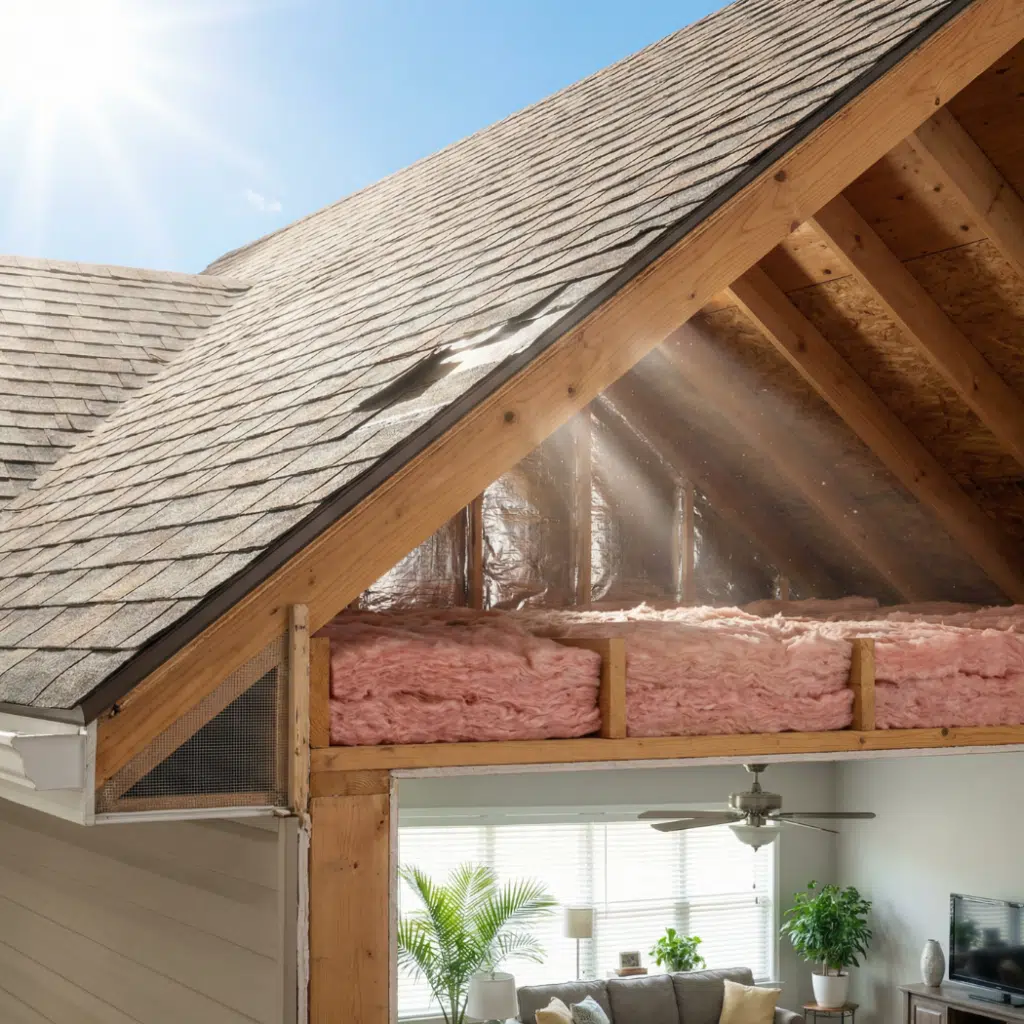
Most Springfield homeowners think about their roof when something goes wrong. What fewer people realize is that the roof and attic above them affect how comfortable their home feels and how hard their HVAC system works every single day, not just during a storm. This guide explains how your roof, attic insulation, and ventilation work together, what the most common comfort problems signal, and how Teague Roofing Plus can spot issues during a roof inspection before they become bigger problems.
TLDR: In Southwest Missouri’s hot summers and cold winters, a poorly ventilated or under-insulated attic makes some rooms miserable, runs up energy bills, and shortens the life of your roof from the inside. The roof, attic insulation, and ventilation have to work together to keep your home comfortable and your shingles performing as designed. Teague flags attic and ventilation issues during every roof inspection and can make improvements during roofing projects.
You have probably noticed it. Upstairs in August feels like a different climate than the rest of the house. The AC runs all afternoon and the bedroom still feels warm when you go to bed. In winter, there are cold drafts in certain rooms that the furnace never quite handles.
These are not always HVAC problems. Sometimes the real issue is what is happening above the ceiling, in the attic, and at the roof surface. When insulation is thin and ventilation is poor, the attic turns into a heat trap in summer and a moisture trap in winter. That affects your living space, your energy bills, and the shingles above it.
This guide explains the connection in plain language and gives Springfield-area homeowners a practical way to think about their roof as part of a larger comfort system.
Why Roof and Attic Comfort Problems Show Up So Often in Southwest Missouri
Southwest Missouri produces genuinely demanding conditions for roofs and attics. Summers are hot and humid, with temperatures that push attics into extreme heat if ventilation is inadequate. Winters bring cold fronts, freeze-thaw cycles, and enough temperature swings to stress every component of the roof system. The same region that bakes in July is dealing with ice storms in February.
Without good insulation and ventilation working together, attics across Springfield, Nixa, and Ozark become heat sinks in summer and moisture traps in winter. In summer, an attic cooking at extreme temperature transfers heat downward into the living space, making upper floors uncomfortable and forcing cooling systems to work harder than they should. In winter, warm air rising from the living space and hitting cold attic surfaces creates condensation, which over time stains decking, degrades insulation, and accelerates the kind of moisture damage that shortens roof life.
Teague Roofing Plus sees this pattern regularly on homes across the region. What often looks like a shingle problem from the street turns out to have an attic component that has been adding stress to the roof system for years.
| Season | What Happens in the Attic | How It Feels Inside |
|---|---|---|
| Summer | Heat builds up rapidly without adequate ventilation | Upper floors hot and stuffy; AC runs constantly without catching up |
| Winter | Warm air rises into attic; moisture condenses on cold surfaces | Cold spots in upper rooms; possible frost or moisture on decking |
| Storm season | Wind-driven rain tests every gap; temperature swings stress materials | Leaks may appear; comfort issues spike after weather events |
Roof, Attic, Insulation, and Ventilation: How They Work Together
The roof system is more than just shingles. It is a layered assembly where each component has a specific job, and when any one of them underperforms, the others work harder to compensate.
The roof covering, whether asphalt shingles, metal, or another system, is the primary water and weather barrier. Under it, the underlayment adds a secondary layer of protection against water infiltration. The decking is the structural surface everything attaches to. Below the decking, inside the attic, insulation slows the movement of heat between the attic space and the living area below. Ventilation, typically through ridge vents at the peak and soffit vents at the eaves, moves hot or moist air out of the attic before it can build up and cause problems.
When all of these work together, the roof stays cooler and drier, the living space stays more comfortable, and the whole system lasts longer. When any piece fails or underperforms, the effects ripple through the others.
Our roof replacement projects always include an assessment of the ventilation system, and as an established Springfield roofing company since 1971, we understand how each layer of the system performs in SW Missouri’s specific climate.
| Part | Where It Is | What It Does |
|---|---|---|
| Roof covering | Outermost layer on the roof surface | Sheds water and protects everything below from weather |
| Underlayment | Between the shingles and the decking | Secondary water barrier; protects decking if surface is compromised |
| Decking | Structural layer shingles attach to | Structural foundation for the whole roofing system |
| Attic insulation | Floor of the attic above the living space | Slows heat transfer between attic and living space in both directions |
| Ridge and soffit vents | Peak of the roof and underside of eave overhangs | Move hot, moist air out of the attic through a natural airflow path |
Common Comfort and Energy Complaints Teague Hears: What They Often Mean
Homeowners in Willard, Rogersville, and Strafford bring up the same complaints repeatedly during inspections. These patterns are consistent enough that they often point toward specific underlying issues.
An upper floor that stays noticeably hotter than the rest of the house in summer usually points toward insufficient attic insulation, blocked or inadequate soffit vents, or a combination of both. The attic heat is transferring downward into the living space faster than the insulation can resist it. A cooling system that runs continuously in August without bringing upper rooms to a comfortable temperature is often working against the same problem from the other direction.
Frost or moisture visible in the attic during winter checks means warm, moist air from the living space is reaching cold surfaces and condensing. This is an air sealing and ventilation issue that can damage decking and framing over time, and it often shows up alongside inadequate insulation that allows the attic to get cold enough for condensation to occur. A musty smell concentrated in upper rooms or from the attic access is a signal that moisture has been building up for a while.
Energy bills that seem high compared to similar homes in the neighborhood are worth a layered look: roof and attic conditions, window and door sealing, and HVAC function all contribute.
A free roof inspection from Teague includes an attic check when accessible. We flag what we see, explain what it means, and note what falls in the roofing lane versus what belongs with an insulation or HVAC professional. Our full range of exterior services addresses connected exterior components that also affect comfort, including siding and windows.
| What You Notice | Possible Cause | Who Should Check It |
|---|---|---|
| Upper floors much hotter than lower floors in summer | Inadequate attic insulation or blocked soffit vents | Teague inspection for ventilation; insulation pro for insulation work |
| Cold drafts in upper rooms in winter | Air leaks at attic penetrations or inadequate insulation | Teague can flag; energy auditor or insulation pro for full assessment |
| Frost or moisture on attic decking in winter | Warm air reaching cold surfaces; ventilation or air sealing issue | Teague can identify; insulation or energy pro for air sealing work |
| Musty smell from attic or upper rooms | Moisture buildup from poor ventilation or air sealing failure | Teague attic check; mold or insulation pro if significant |
Attic Insulation Basics for Springfield Homeowners
The U.S. Department of Energy identifies the attic as one of the most important places to insulate in a home. Heat rises, and in a home with thin or inadequate attic insulation, that heat moves freely between the living space and the attic in both directions. In summer, attic heat transfers down. In winter, interior heat transfers up and out.
ENERGY STAR’s insulation R-value guidance notes that for climates like Missouri, attics often need a significantly higher insulation level than what many older homes currently have. A common situation Teague encounters during roof inspections is an attic with only a few inches of aging insulation, well below what DOE guidance recommends for the region. Older homes in Springfield, Battlefield, and Fair Grove frequently fall into this category.
Teague is not a full insulation contractor, but our team spots obvious insulation deficiencies during roof and attic checks and can point homeowners toward the next steps. If a roof inspection reveals clearly inadequate insulation at the attic floor, we note it in the report and recommend connecting with an insulation professional for a proper assessment and installation.
| Condition | What the Attic Does | How It Affects Comfort |
|---|---|---|
| Poor or thin insulation | Heat moves freely between attic and living space | Hot upstairs in summer, cold in winter, higher energy use year-round |
| Improved insulation at recommended levels | Slows heat transfer in both directions | More consistent temperatures, less HVAC strain, lower energy demand |
Attic Ventilation and Roof Life: Why It Matters in Missouri
ENERGY STAR’s attic ventilation guidance explains how ridge and soffit vents work together to create a natural airflow path through the attic. Cool air enters at the soffits along the eave, flows upward through the attic, and exits at the ridge vent at the peak. This movement flushes out heat in summer and moisture-laden air in winter before either can accumulate and cause damage.
The DOE’s Guide to Durable Attics connects proper ventilation and air sealing directly to longer roof life. When hot, moist air stays trapped in the attic, it raises the temperature of the roof decking from below. That heat adds stress to the shingles above. In winter, condensation from trapped moisture soaks into wood framing and decking, creating conditions for rot and mold that are not visible from the street.
In hot Missouri summers, an unventilated or under-ventilated attic can reach extreme temperatures that accelerate granule loss and shorten the effective life of asphalt shingles, even when the shingles look fine from the ground.
When Teague installs a new roof or performs major roof repair services, we evaluate the existing ventilation system and add or improve ridge and soffit vents where needed. A new roof installed over a poorly ventilated attic will not last as long as the same roof installed with proper airflow.
| Ventilation Level | Attic Conditions | Roof and Comfort Effects |
|---|---|---|
| Poor ventilation | Heat and moisture build up; decking temperatures extreme | Accelerated shingle aging; moisture damage to framing; hot living spaces |
| Balanced ridge and soffit ventilation | Hot, moist air exits continuously; attic stays closer to outside temperature | Longer roof life; reduced moisture risk; more comfortable living space |
Our roof replacement team includes ventilation assessment as a standard part of every project.
Simple Checks Springfield Homeowners Can Do (Without Climbing on the Roof)
You do not need to climb on the roof or hire anyone to do a useful first check on your attic and roof system. Most of the useful observation happens from the attic hatch, the living space, and the ground.
From the attic hatch, use a flashlight and look at the insulation level. If you can see the tops of the floor joists or if the insulation looks thin and compressed, it is likely below what DOE recommends for the region. Look along the underside of the decking for dark staining, soft areas, or frost in cold weather. Any of these signals moisture has been active. Look toward the eave edges to see if the soffit vents appear blocked by insulation that has been pushed too close to the edge.
From the living space, note which rooms are hardest to keep comfortable across the seasons. Upper rooms that are consistently warmer in summer and cooler in winter than the rest of the house are pointing at the attic. Ceiling stains that appear or grow after heavy rain point at the roof.
From the ground, look at the soffit overhang for any vents that appear blocked, painted over, or stuffed with debris. Look at the ridge for a continuous vent strip along the peak, which indicates a ridge vent is present. Note any areas where the roofline looks uneven or where gutters appear to be pulling away from the fascia.
If any of these checks turn up concerns, schedule a free roof inspection and let Teague take a closer look.
| Where | What to Look For | Next Step |
|---|---|---|
| Attic hatch | Thin or compressed insulation; staining on decking; frost in winter | Note findings; call for professional inspection |
| Ceilings in living space | New stains after rain; rooms that are consistently hard to condition | Monitor; call if stains appear or worsen |
| Exterior eaves and roofline | Blocked soffit vents; uneven rooflines; gutters pulling from fascia | Check soffit blockage yourself; call for inspection if roofline concerns |
When Roof and Attic Work Together to Improve Comfort
A roof replacement is one of the best opportunities to improve both the exterior protection and the attic conditions of your home at the same time. When the old roof comes off and the decking is exposed, Teague has access to the ventilation system and the attic edge conditions in ways that are not available between projects.
During a replacement, our team evaluates whether ridge and soffit vents are present, properly sized, and functioning. If they are not, we add or improve them as part of the project. We look at the insulation condition visible at the attic edge and note anything that warrants attention by an insulation professional. We also consider how material choices, including shingle color and whether light-colored or reflective options make sense, fit the homeowner’s style preferences and comfort goals.
Research on roof and attic system improvements consistently shows that better ventilation and improved insulation reduce energy use and improve comfort in hot climates, with the largest gains in homes that are starting from a poor baseline. We do not promise specific savings percentages for any individual home, because the actual benefit depends on the starting condition and the full set of improvements made. What we do is make sure the roof we install is working with the attic rather than against it.
| Upgrade | What Teague Does | How It Helps |
|---|---|---|
| Add or improve ridge vents | Install continuous ridge vent along the peak during reroofing | Allows hot, moist attic air to exit at the highest point of the roof |
| Open or add soffit vents | Confirm soffit vents are clear and supplement if needed | Provides the cool air intake that makes ridge vents work correctly |
| Address insulation gaps at eaves | Note deficiencies and recommend insulation pro for follow-up | Prevents insulation from blocking soffit airflow and identifies upgrade needs |
Frequently Asked Questions: Roof, Attic, and Energy Efficiency in Springfield, MO
Will a new roof make my home more energy efficient?
A new roof alone does not transform energy efficiency, but it can be part of a meaningful improvement when paired with better ventilation and attic insulation. A properly ventilated new roof reduces attic heat buildup compared to a worn roof with blocked vents. Light-colored or reflective shingle options reduce solar heat gain on the roof surface. The biggest energy and comfort gains typically come from addressing the attic insulation and air sealing alongside the roofing work, which is why Teague flags attic conditions during every inspection.
How do I know if my attic has enough insulation?
Open the attic hatch and look with a flashlight. If you can see the tops of the floor joists, or if the insulation looks thin and flat, it is likely below what DOE and ENERGY STAR recommend for Missouri’s climate. The right level depends on the specific climate zone and the insulation type, but a quick look tells you a lot. If the insulation looks thin, compressed, or damp, those are all reasons to call for a professional assessment from an insulation contractor. Teague can also note obvious insulation deficiencies during a roof inspection.
Why is my upstairs so much hotter than my downstairs in summer?
Heat rises, and if the attic above the upper floor is not insulated and ventilated adequately, that heat transfers down into the living space faster than your cooling system can remove it. Upper floors always run warmer than lower floors in most homes, but a dramatic difference usually points at thin attic insulation, blocked soffit vents, or an absence of ridge ventilation. These are all things Teague can evaluate during a free inspection.
Can poor attic ventilation really damage my roof?
Yes. When heat and moisture build up in an attic without adequate ventilation, the temperature of the roof decking rises significantly from below. That heat accelerates the aging of the shingles above it and increases granule loss. In winter, moisture-laden air condensing on cold decking contributes to wood rot and mold in the attic framing. A roof that looks fine from the street can be aging faster than expected because of what is happening on the underside.
Do you add or fix roof vents when you replace a roof?
Yes. Teague evaluates ventilation as a standard part of every roof replacement. If ridge vents are missing, undersized, or paired with blocked soffit vents, we address the issue during the project. A new roof installed over an inadequate ventilation system will not perform or last as well as it should. Getting ventilation right during the replacement is far more practical than adding it separately later.
Who should I talk to about adding more attic insulation?
An insulation contractor or a home energy auditor is the right professional for attic insulation work. Teague is not a full insulation contractor, but we flag obvious deficiencies during roof and attic checks and can point you toward next steps. If a free inspection reveals that the attic insulation looks thin or compromised, we will tell you clearly and recommend consulting an insulation professional. Getting the roof and insulation addressed together when both are needed makes sense from a timing standpoint.
What should I expect during a roof and attic check from Teague Roofing Plus?
Our inspection covers the full roof surface, flashing, gutters, and ventilation system from the exterior. When the attic is safely accessible, we check for moisture, staining, insulation conditions, and ventilation function. We photograph everything and explain the findings in plain language before leaving. If we see something that requires an insulation or HVAC professional rather than a roofer, we say so clearly. The inspection is free, takes 45 to 90 minutes depending on roof size, and comes with no obligation.
Key Takeaways for Springfield Homeowners
- The roof and attic work as a system. Shingles protect from outside. Insulation slows heat movement. Ventilation flushes out heat and moisture. All three have to function together.
- Hot upstairs rooms and high energy bills often point at the attic. Thin insulation and blocked vents are among the most common causes of comfort problems in older SW Missouri homes.
- Poor ventilation shortens roof life. Heat trapped in the attic ages shingles from below and creates moisture conditions that damage decking and framing over time.
- Roof replacement is a good time to fix ventilation. When the old roof comes off, Teague evaluates and improves the ventilation system as part of the project.
- Teague identifies attic issues during inspections. We note what we see, explain what it means, and point you toward the right professional for any work outside the roofing lane.
- A free inspection is the practical first step. If you are noticing comfort problems, high bills, or any of the symptoms in this guide, a roof and attic check costs you nothing and gives you a clear starting point.
Want a Roof and Attic Check to Help with Comfort and Bills?
If you have been fighting a hot upstairs all summer, noticing energy bills that seem higher than they should be, or finding moisture concerns in the attic, a free roof and basic attic check from Teague Roofing Plus gives you a clear picture of what is happening above your ceiling.
Teague has been working on roofs across Springfield, Nixa, Ozark, Republic, Marshfield, and every community in SW Missouri since 1971. Our team knows how this region’s climate affects roof and attic performance, and we flag what we see rather than just reporting on the shingles and moving on. Josh and the team will inspect the full roof, check the accessible attic areas, show you photos of the findings, and explain clearly what falls in the roofing lane and what needs an insulation or energy professional.
Call 417-883-7663 or contact us online to schedule your free inspection. You can also learn more about us and our history in Southwest Missouri before you call.
Teague Roofing Plus | Roofing, Siding, Windows, Gutters, and More. Serving Southwest Missouri Since 1971.