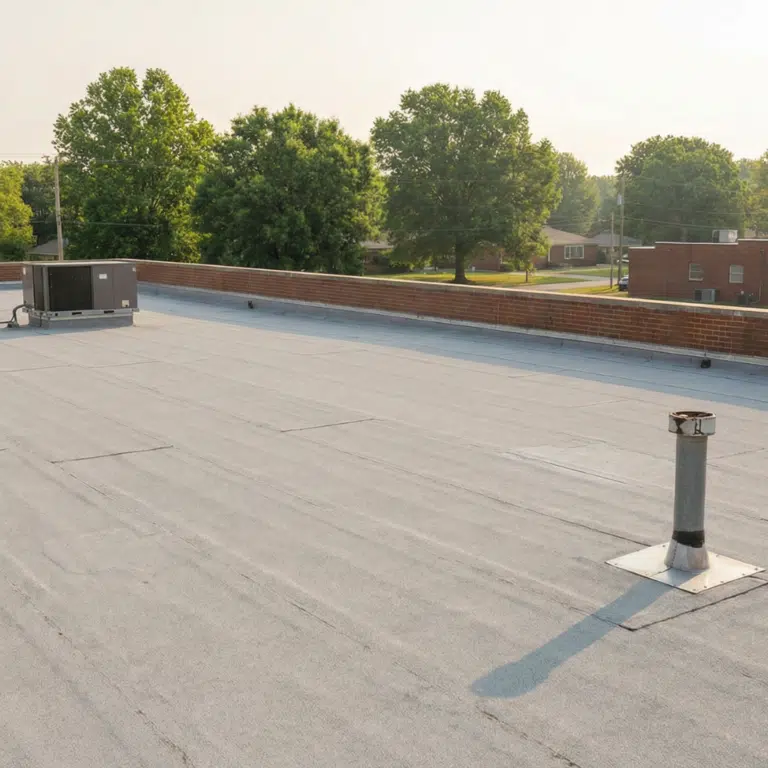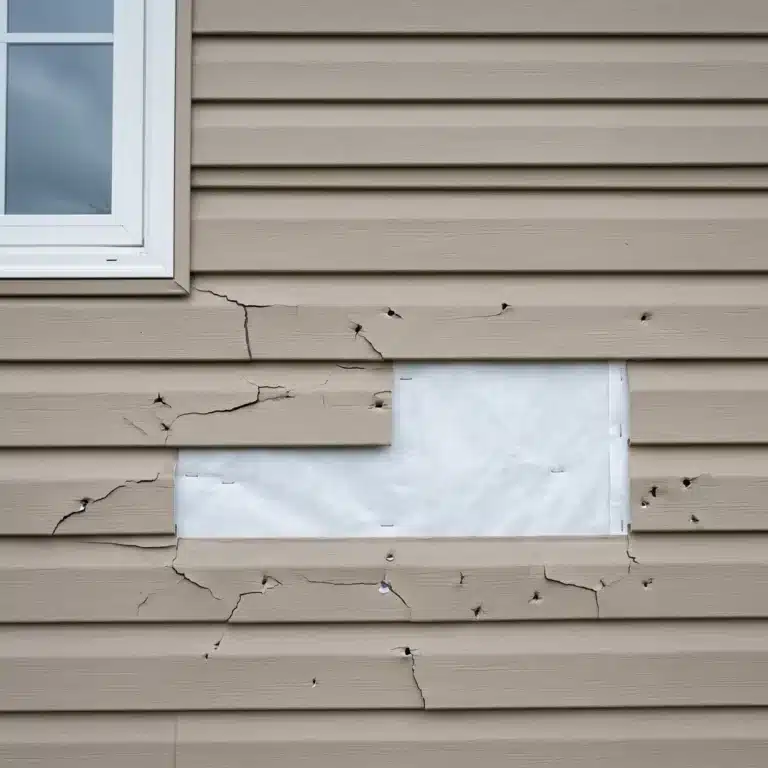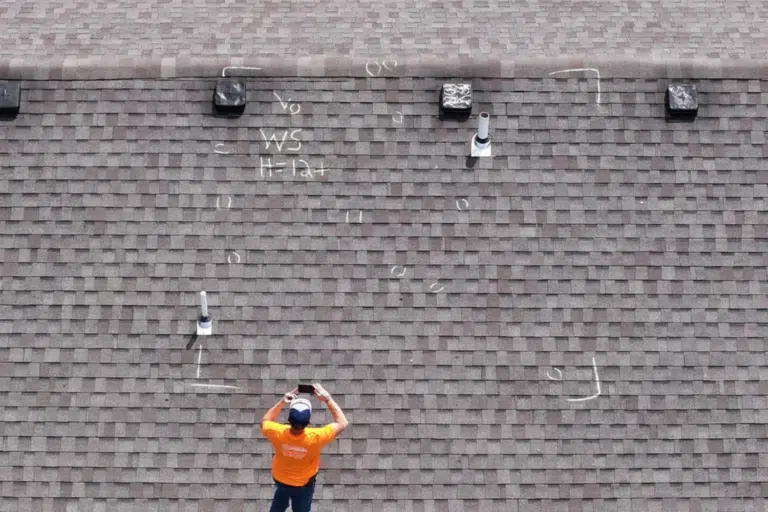

Missouri homeowners with metal roofs experience storms differently from neighbors with shingles. Hail dents metal instead of bruising it, and insurance companies treat those dents differently from shingle damage. This guide explains how hail and wind actually affect metal roofs, when dents matter, how cosmetic exclusions work, and what to do if you see damage on your metal or shingle roof after a storm.
TLDR: Metal roofs often survive hail and wind without leaks, but they can still be visibly dented. Insurance companies frequently call dents “cosmetic” and deny claims if the roof still sheds water. Shingle roofs are more likely to qualify for replacement when functional damage is documented. If you see dents or ripples after a storm, get a professional inspection before you accept “cosmetic only.”
Two SW Missouri homeowners. Same storm, same hail size. One has a standing-seam metal roof, the other has architectural shingles. The shingle roof is getting replaced under a covered claim. The metal roof claim came back denied as “cosmetic damage only,” even though the panels are visibly dented from the street.
Same storm, two outcomes. The materials respond differently to hail and wind, and so do insurers. “No leaks” does not automatically mean “no problem,” but it is also true that metal can be structurally fine even when it looks rough. The question for the homeowner is which side of that line their damage falls on, and what they can do about it either way.
The rest of this guide gives you the framework. We cover both metal and shingles because most homeowners ask about both, and the right answer depends on which one is on your house.
How Storms Actually Damage Metal vs. Shingle Roofs
Different materials fail differently. The visible signs, the leak risk, and the insurance treatment all branch from there.
Hail on Asphalt Shingles (Quick Recap)
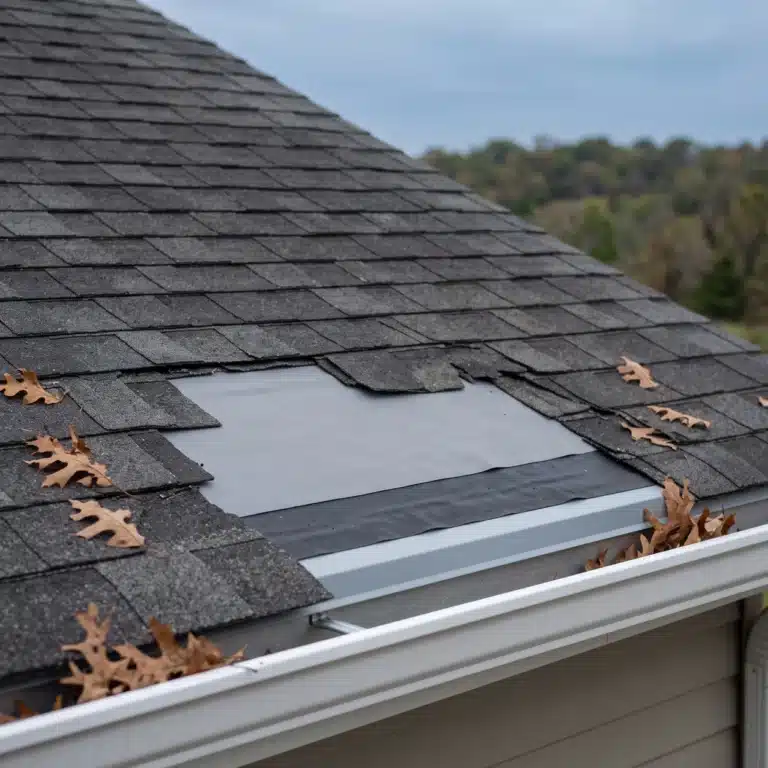
Asphalt shingle hail damage takes three forms: granule loss (ceramic granules knocked off the surface), mat bruising (fiberglass reinforcing mat fractured below the surface), and cracking or puncture at higher hail sizes. Bruising is invisible from the ground and requires an on-roof tactile check. The damage is functional even before leaks appear because granule loss accelerates UV degradation and bruising compromises structural integrity. For more on shingle-specific hail damage, see our hail damage roof inspection guide.
Hail on Metal Roofs
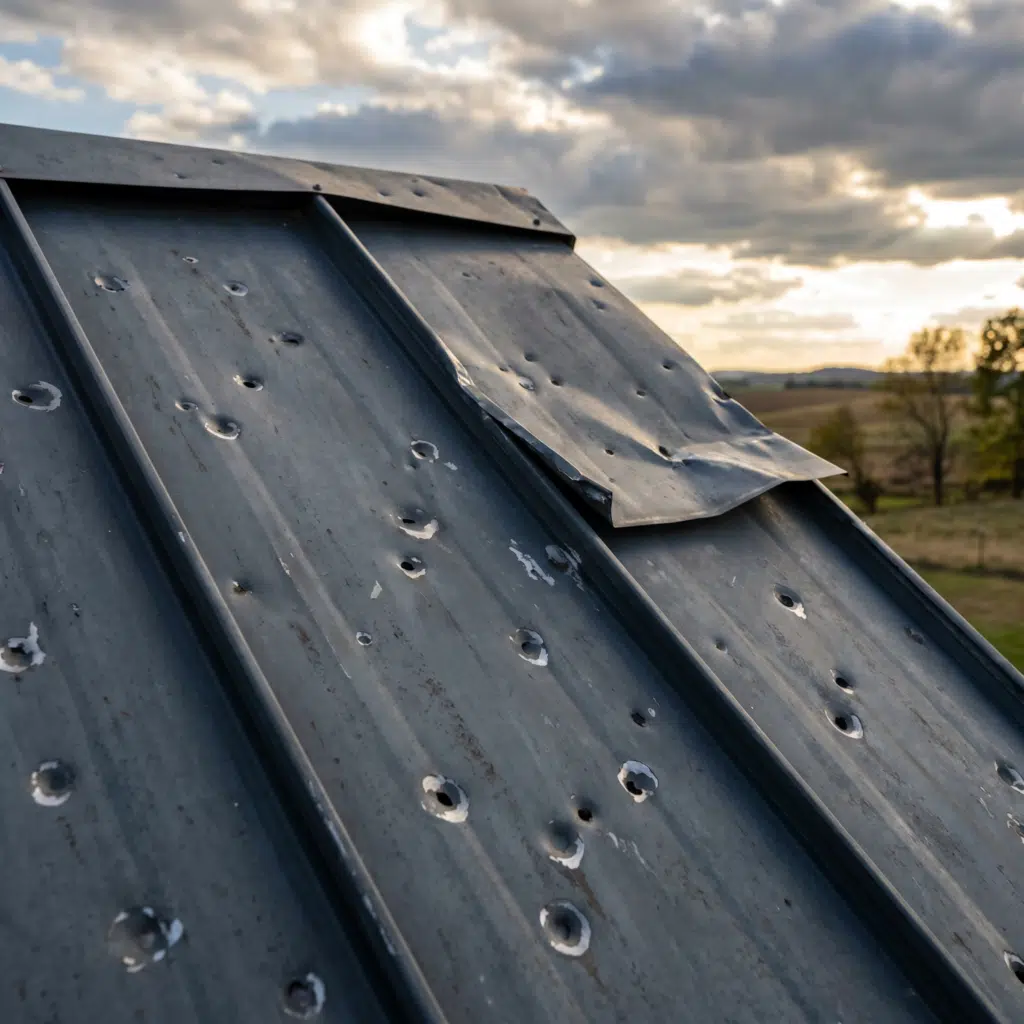
Hail hits metal differently. The stone strikes a flat panel pan or a raised rib. Three things can happen:
- Dents in flat pans without changing the panel’s water-shedding geometry
- Deformation of ribs at the edges where panels lock or overlap
- Paint and coating damage ranging from light scuffing to chips that expose bare metal
The first one is often cosmetic. The second and third can be functional. The reason is water management: metal roofs shed water through panel geometry, intact seams, and protective coatings. As long as those three things are working, the roof remains watertight regardless of how it looks. When hail compromises any of them, the system has been damaged whether it leaks today or not.
| Feature | Asphalt Shingles | Metal Roofing |
|---|---|---|
| Typical hail effect | Granule loss, bruising, broken tabs | Dents, paint scuffs, possible seam deformation |
| Leak risk | Increases quickly with bruising and cracks | Lower if seams stay intact, leaks show mainly at penetrations |
| Insurer focus | Functional damage (bruises, granule loss, cracks) | Cosmetic vs. functional, cosmetic exclusion clauses |
| Common claim outcome | Replacement when damage is documented | Denials or limited coverage if classified cosmetic |
“It did not leak” is not the only question. Insurers ask whether performance and life expectancy changed, and contractors are trained to look for that even when the surface still appears watertight.
Cosmetic vs. Functional Damage on Metal: Why It Matters So Much
This is the line every metal roof denial letter sits on. Understanding it changes whether you accept the denial or challenge it.
Cosmetic damage: dents and surface changes that do not shorten service life or change water-shedding performance. Shallow dents in panel pans with intact coating typically fall in this category.
Functional damage: any impact that impairs panel integrity, protective coatings, seams, or fasteners enough to shorten lifespan or increase leak risk, even if leaks have not started yet. This is the category that drives covered claims.
| Type | Example | Insurance Likely to Say | Contractor Perspective |
|---|---|---|---|
| Cosmetic | Shallow dents in panel pans with intact coating | Cosmetic-only, no coverage if exclusion applies | May not impact performance now |
| Cosmetic | Light scuffing of paint with no exposed metal | Cosmetic, no claim if excluded | Watch for future coating breakdown |
| Functional | Creased ribs at panel seams | Functional, may qualify if no cosmetic exclusion | Can weaken seams under wind load |
| Functional | Impact-chipped coating exposing bare metal | Functional, corrosion risk | Shortens panel life, repair or replace |
| Functional | Fastener or flashing damage causing gaps | Functional, leak risk | Needs prompt repair or replacement |
A good inspection report draws this line clearly. It identifies each damage point, classifies it as cosmetic or functional with the reasoning, and ties functional damage back to performance impact (corrosion exposure, seam compromise, fastener pull-out, water trap formation). That report is what changes denial outcomes when the original adjuster classified everything as cosmetic.
Pro Tip: When you photograph metal roof damage, zoom in on seams, penetrations, and panel edges. Dents in those locations are stronger evidence of functional impact than dents in wide flat pans alone. Adjusters and carriers respond to seam-area documentation more than they respond to general overview shots.
How Insurance Policies Treat Metal vs. Shingle Damage
Coverage type and exclusion language drive most of the difference between metal and shingle claim outcomes in Missouri.
Cosmetic Damage Exclusions for Metal Roofs
A cosmetic damage exclusion is policy language that limits coverage to performance problems only, not appearance changes. If your metal roof policy includes one, dents that do not affect water-shedding or panel integrity are excluded from coverage regardless of how visible they are from the street.
An increasing number of Missouri policies now include cosmetic exclusions specifically for metal roofs. The exclusion language is sometimes general, sometimes narrowly defined to specific perils like hail. Pull your declarations page and look for “cosmetic damage exclusion,” “metal roof cosmetic,” or similar language. The Missouri Department of Commerce and Insurance consumer page provides guidance on reading homeowners policy language and a helpline at 800-726-7390 for questions about specific exclusions.
If your policy has a cosmetic exclusion, the appeal path is to document functional damage. Cosmetic exclusions do not block functional damage claims. The classification is the entire battle.
ACV vs. RCV on Long-Lived Metal Roofs
Metal roofs can be 40 to 70 year systems. That changes the depreciation math compared to a 20 to 25 year shingle roof. An older metal roof on Actual Cash Value coverage can produce a much smaller settlement than its replacement cost because depreciation has been compounding for decades. Replacement Cost Value coverage is more protective, paying replacement cost minus deductible, but some carriers restrict RCV on older roofs regardless of material.
| Topic | Asphalt Shingles | Metal Roofing |
|---|---|---|
| Common policy note | Often full coverage, no cosmetic exclusion | Often includes cosmetic damage exclusion |
| Claim scrutiny | High but straightforward | Very high, cosmetic vs. functional heavily debated |
| ACV vs. RCV impact | Shorter life, depreciation steeper but replacement cheaper | Longer life, slower depreciation but replacement higher |
| Typical documentation | Test squares, granule loss photos | Close-ups of seams, ribs, coating, fasteners |
Pro Tip: Before your next storm, pull your declarations page and check three things: whether your roof is on RCV or ACV, whether a cosmetic damage exclusion applies to metal, and your wind/hail deductible. Knowing all three before the claim conversation puts you ahead of where most homeowners start.
After a Storm: What a Metal Roof Owner in SW Missouri Should Actually Do
- Check from the ground and with binoculars. Look for broad patterns of dents, especially on flat pans and the top sides of panels. Compare slopes that faced the storm to those that did not. Directional damage patterns are stronger evidence than scattered impressions.
- Check soft metals and other clues. Look at gutters, downspouts, AC fins, and metal flashings. If those are dented in a hail pattern, your roof almost certainly took hits too. Soft metal damage is independent corroboration of hail size and density.
- Photograph everything in good light. Capture wide shots and close-ups, especially seams, fasteners, ribs, and paint chips. Save to a date-stamped folder. Pull the storm event record from NWS Springfield for your county and date.
- Call us before you call your insurance company. A free storm damage inspection gives you an independent read on whether the damage looks cosmetic or functional, and whether a claim makes sense before the claim is on record.
- If you have shingles, follow the same steps. We handle both metal and shingles. Shingle claims are often more straightforward to document under a functional damage standard, and our free roof inspection covers both materials with the same level of detail.
Pro Tip: Build a pre-storm baseline every two to three years on a metal roof. Walk the perimeter, photograph every slope, every seam, and every penetration, and date-stamp the folder. That baseline proves dents and coating damage are new and storm-related, not older wear, the next time a storm rolls through. It is the single most useful piece of documentation a metal-roof homeowner can build proactively.
When Should a Metal Roof Be Repaired vs. Replaced After Storm Damage?
Minor cosmetic dents usually do not require replacement for performance reasons, though they can affect resale value or aesthetics if they are widespread. Functional damage or large-scale panel deformation may justify replacement, especially under RCV coverage where insurance covers the difference.
| Scenario | Likely Recommendation | Notes |
|---|---|---|
| Shallow dents in pans only, coating intact | Monitor or cosmetic-only repair | Claim may be denied if cosmetic exclusion applies |
| Dents plus chipped coating exposing metal | Repair or panel replacement | Functional damage, document for claim |
| Creased ribs along several panels | Consider broader replacement | Structural performance may be compromised |
| Fasteners pulled, flashings bent, minor leaks | Targeted repair | Address quickly to prevent further damage |
| Widespread deformation across multiple slopes | Replacement | Treat like a major loss event, claim usually appropriate |
The 70% rule applies to metal roofs the same way it does to shingles. If repair cost approaches 70% of the cost of roof replacement, replacement is the better long-term decision, especially when insurance covers a meaningful share of the work.
Metal vs. Shingle: Which Handles Missouri Storms Better?
Both materials can perform well in SW Missouri. The differences matter at the edges.
Metal: sheds snow and ice well, strong wind resistance when properly installed and fastened, resists burning embers, and hail typically dents rather than penetrates. The trade-off is that dents are visible and insurance treatment is more complicated due to cosmetic exclusions and stricter scrutiny.
Shingles: more vulnerable to granule loss and wind uplift, but easier and cheaper to repair. The insurance process is more mature and often more straightforward. Standard shingles are rated 60 to 90 mph, with Owens Corning Class 4 impact-resistant products rated higher for hail and wind.
The choice is not just about storm performance. It is about insurance terms (especially cosmetic exclusions), long-term ownership plans, and whether you want a 20 to 25 year shingle system or a 40 to 70 year metal one. We install both and can walk through the trade-offs honestly during a free inspection at locations across SW Missouri including Clever and Marionville.
Frequently Asked Questions
Does hail damage a metal roof, or does it just leave dents?
Both. Smaller hail typically leaves dents in flat panel pans without affecting water-shedding. Larger hail can deform ribs at seams, chip protective coatings, and damage fasteners or flashings. Whether the damage is cosmetic or functional depends on whether panel integrity, coatings, or seams were compromised. A professional inspection is the only reliable way to tell.
Will my insurance pay for hail damage to a metal roof in Missouri?
It depends on your policy and the type of damage. If your policy includes a cosmetic damage exclusion, dents that do not affect performance may not be covered. Functional damage (compromised seams, chipped coating, deformation that affects water shedding) is usually covered. Pull your declarations page and get a professional inspection before deciding whether to file.
What is cosmetic hail damage on a metal roof?
Cosmetic damage is dents, surface ripples, or paint scuffs that do not reduce water-shedding ability or shorten the roof’s service life. Shallow dents in panel pans with intact coating are the most common example. Cosmetic damage may not be covered if your policy includes a cosmetic exclusion.
How do I know if the damage to my metal roof is functional, not just cosmetic?
Look for damage at seams, fasteners, panel ribs, and edges, not just in flat pans. Coating chips that expose bare metal are functional because they create corrosion risk. Creased ribs at seams compromise wind and water resistance. Fastener or flashing damage creates leak paths. A professional inspector documents these specifically and explains why each constitutes functional damage.
Is a dented metal roof still safe to leave as is?
Often yes, if the dents are shallow, the coating is intact, and seams and fasteners are not affected. The risk is that what looks cosmetic today can become functional over time as compromised coating allows corrosion to spread or hidden seam damage opens under wind load. Get an inspection so you know what you are looking at and whether monitoring is appropriate.
Why did my shingle roof get approved for replacement but my neighbor’s metal roof claim was denied?
Different materials trigger different insurer responses. Shingle claims often qualify when functional damage (granule loss, bruising) is documented, because most policies do not exclude shingle cosmetic damage. Metal roof claims face cosmetic exclusion language and tighter scrutiny. The same storm can produce a covered shingle claim and a denied metal claim under standard Missouri policies.
What should I ask my insurance agent before switching from shingles to metal?
Ask whether your policy has a cosmetic damage exclusion that applies to metal roofs, whether RCV coverage is available for the metal system, whether the replacement cost has been updated to reflect the new material, and what the wind/hail deductible looks like under the revised policy. Get the answers in writing before the install.
How does Teague Roofing Plus inspect metal roofs for storm damage?
Our team checks panel pans for dent patterns, examines seams and ribs for deformation, looks at coatings for chips that expose bare metal, checks fasteners and flashings for impact damage, and documents all of it in a written report that classifies each damage point as cosmetic or functional with reasoning. The inspection is free and the report is designed to support an insurance claim if one is appropriate.
Can I switch from metal back to shingles after a storm-damage claim?
Yes, within policy and code limits. The replacement scope determines the material options, and switching materials may require an updated policy with the carrier. We can walk through the cost, performance, and insurance implications of switching during the inspection.
Is metal roofing still a good choice in Missouri hail country?
Yes, with eyes open. Properly installed metal roofs handle wind and shed precipitation well, and they typically last 40 to 70 years. The trade-off is that hail can dent visible panels and insurance treatment is more complicated than with shingles. The decision depends on how long you plan to own the home, how you weigh appearance vs. longevity, and what your policy looks like.
Key Takeaways
- Metal and Shingles Fail Differently: Shingles bruise and lose granules. Metal dents and deforms. Different signs, different insurance treatment, different inspection focus.
- Cosmetic Exclusions Matter: An increasing number of Missouri metal roof policies include cosmetic damage exclusions. Pull your declarations page before the next storm.
- Functional Damage Is the Claim Key: Compromised seams, chipped coating exposing metal, deformed ribs, and damaged fasteners are functional damage. They can be claimed even with a cosmetic exclusion.
- Documentation Beats Guesswork: Photograph seams, ribs, fasteners, and coating chips. Pull the NWS storm event record. Build a pre-storm baseline every two to three years.
- 70% Rule Still Applies: When repair approaches 70% of replacement cost, replacement is the better long-term call, especially under RCV coverage.
- Material Choice Is Not Just About Storms: Insurance terms, ownership timeline, and long-term performance all factor in alongside hail and wind resistance.
- Teague Knows Both Systems: We install metal and shingles. We inspect both with the same level of detail. We document functional damage in the language carriers respond to.
See Dents on Your Metal Roof? Let’s Find Out What They Actually Mean.
You are not stuck with “cosmetic only” as the final answer. The first step is understanding what kind of damage you actually have, and that does not cost anything.
Teague Roofing Plus inspects metal and shingle roofs across SW Missouri, and we know how local carriers treat cosmetic vs. functional damage. We document what the roof shows in the language adjusters respond to.
What comes with calling us:
- Free inspection covering panels, seams, ribs, fasteners, coatings, and flashings on metal, or full hail and wind documentation on shingles
- Written damage report classifying each point as cosmetic or functional with reasoning
- Experienced inspectors on every job, with project managers running the file
- Owens Corning Platinum Preferred Contractor (less than 1% of roofers nationally) for shingle work, with Class 4 impact-resistant options available
- Insurance claim assistance at no extra charge, including on-site adjuster meetings
- Thousands of roofs in SW Missouri since 1971
- All permits handled
We serve communities across Southwest Missouri.
Owner Josh Tessmer runs Teague Roofing Plus on the principles the company was founded on in 1971: do honest work and stand behind it.
Call 417-883-7663 or contact us online.
Teague Roofing Plus | Roofing, Siding, Windows, Gutters, and More. Serving Southwest Missouri Since 1971.