
Most homeowners think of gutters as a simple add-on, until water starts running down the siding or pooling near the foundation. Gutter installation involves more decisions than people expect: sizing, slope, hanger spacing, and where the water goes once it leaves the roof. This guide walks through what a proper install looks like in Southwest Missouri.
TLDR: A gutter system is sized and pitched for the roof above it, not chosen off a shelf. Undersized gutters and poorly placed downspouts are the usual cause of overflow. Seamless gutters reduce leak points, and proper discharge away from the foundation matters more than the gutter itself.
Water has to go somewhere. When a roof sheds a heavy Ozarks downpour, a gutter system either carries that water clear of the house or it does not.
A small set of installation mistakes accounts for most gutter problems on homes in this region. Almost all of them trace back to decisions made before anyone picked up a tool.
Here is what actually goes into a gutter installation, and what to ask before you sign.
Sizing comes first, and most people skip it
Gutter capacity is not a preference. It is a calculation based on roof area, roof pitch, and how hard it rains where you live.
A steeper roof sheds water faster, which means the gutter has to handle a higher flow rate even though the roof area has not changed. Southwest Missouri gets intense short-duration downpours, which is exactly the condition that overwhelms an undersized system.
The National Roofing Contractors Association publishes guidance on roof drainage system design covering how these systems get sized properly.
| Input | Why it matters |
|---|---|
| Roof area draining to that run | Directly sets the volume the gutter must carry |
| Roof pitch | Steeper roofs deliver water faster, raising peak flow |
| Local rainfall intensity | Short heavy storms drive the peak, not annual totals |
| Number of downspouts | More outlets lower the load on each section of gutter |
If a contractor quotes gutters without asking about roof area or pitch, that is your signal to ask how they sized it.
Important: Overflowing gutters are frequently a sizing or downspout problem, not a clog. Cleaning them will not fix it.
Seamless versus sectional
Sectional gutters come in lengths and join together on site. Seamless gutters get rolled to length from a coil at your house, so a run has no joints except at corners and outlets.
Joints are where gutters leak. Fewer joints means fewer future problems. The NRCA maintains a technical library on gutters and roof edge details for contractors working through these choices.
| Type | Joints | Typical outcome |
|---|---|---|
| Sectional | Many along each run | More potential leak points over time |
| Seamless | Corners and outlets only | Fewer failure points, cleaner line |
Seamless is what we install on most homes for that reason. Sectional still has a place on small or awkward runs.
Pro tip: Ask how many joints your quote includes. On a long straight run the answer should be very few.
Slope, hangers, and the details that fail first
A gutter has to pitch toward the downspout. Too little and water stands in the trough. Too much and it looks wrong and dumps at one end.
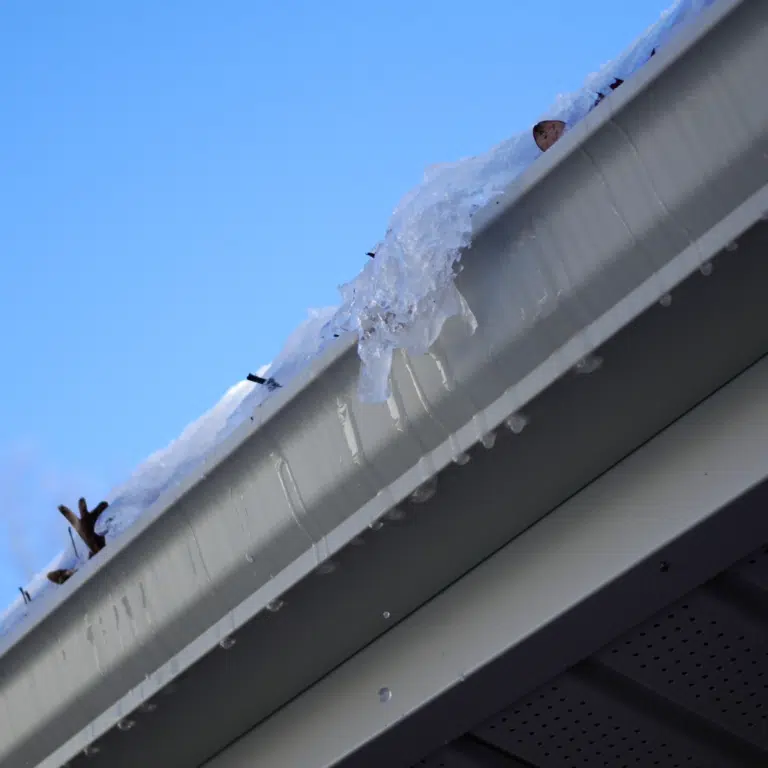
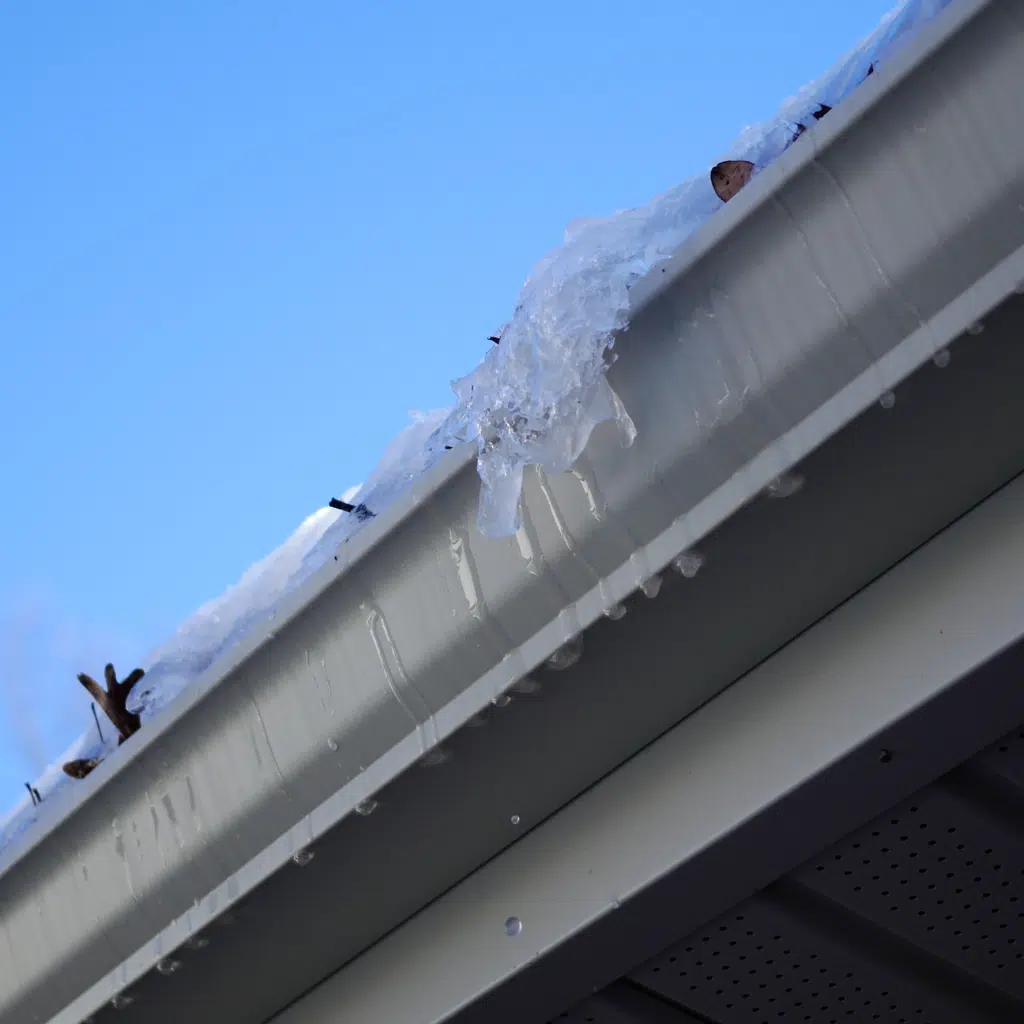
Hanger spacing carries the weight of water, and in this climate, ice. Hangers spaced too far apart let a loaded gutter sag, which creates a low spot, which holds water, which makes the sag worse.
The fascia board behind the gutter matters too. Hangers fastened into soft or rotted fascia will pull loose no matter how good the gutter is.
- Pitch toward the outlet, consistent along the run
- Hangers spaced close enough for water and ice load
- Sound fascia to fasten into
- Proper outlet size where the downspout connects
Tip: Look at your gutters during a hard rain. Water spilling over one spot usually means a sag, a low point, or an outlet that cannot keep up.
Where does the water actually go?
This is the part homeowners forget. A perfect gutter that dumps beside the foundation has moved the problem, not solved it.
Downspouts need to discharge far enough from the house that water does not soak back toward the footing. On properties with grade running toward the home, that often means extensions or buried drain lines.
| Discharge approach | Best for |
|---|---|
| Splash block | Flat lots with good grade away from the house |
| Downspout extension | Lots where water needs to travel farther |
| Buried drain line | Tight side yards or grade sloping toward the home |
Getting water away from the foundation is the entire point of the system.
Pro tip: Walk your foundation after a heavy rain. Standing water within a few feet of the house means the discharge is too short.
Southwest Missouri conditions that change the job
Our weather stacks three problems onto gutters. Heavy spring downpours drive peak flow. Winter ice loads the trough and the hangers. And falling leaves from the oak and hickory that shade most Ozarks properties clog the outlets right before winter.
Industry roofing guidelines treat drainage as part of the roof system rather than an accessory, and that is the right way to think about it here. That combination is why hanger spacing and outlet sizing matter more in this climate. A system that is merely adequate in a dry climate will sag and overflow through a Missouri year.
Homeowners in Springfield and Ozark deal with all three. Our gutter installation service accounts for them in the sizing rather than after the fact.
One useful note on permits: the City of Springfield does not require a permit for routine exterior work like gutter replacement. Structural changes are a different matter.
Important: If your gutters pull loose every couple of years, stop replacing gutters and have someone check the fascia behind them.
How to evaluate a gutter quote
Work through these before you sign anything.
- Ask what roof area and pitch the sizing is based on.
- Ask how many downspouts are included and why that number.
- Confirm seamless or sectional, and how many joints.
- Ask about hanger type and spacing.
- Ask whether the fascia was inspected and whether any needs replacing.
- Confirm where each downspout discharges and how far from the foundation.
- Get the gutter and downspout sizes written on the quote.
Illustrative scenario: A homeowner in Nixa replaces gutters twice in five years. Both times the new gutters sag within two seasons. An inspection finds soft fascia behind the run. Replacing the fascia first solves a problem two gutter jobs did not.
If your current system is failing, an inspection tells you whether the issue is the gutter, the fascia, or the discharge. Our guide to gutter and downspout care covers the maintenance side.
Symptoms point at different causes, and the fix differs with each.
| Symptom | Likely cause |
|---|---|
| Overflow along a long stretch | Undersized gutter or too few downspouts |
| Overflow at one spot only | Sag, low point or blocked outlet |
| Water behind the gutter | Missing or damaged drip edge |
| Gutter pulling away from fascia | Hanger spacing or compromised fascia |
Match the symptom before buying anything.
Tip: Photograph any overflow point during a storm. It is far easier to diagnose from a picture taken mid-rain than from a dry gutter later.
Frequently asked questions
How do I know if my gutters are the wrong size? Overflow during ordinary rain is the clearest sign, especially when the gutters are clean. Water spilling along a long stretch rather than one spot usually points to capacity rather than a clog. Ask a contractor to check the sizing against your roof area and pitch.
Are seamless gutters worth it? They remove most of the joints, and joints are where leaks start. On long straight runs the difference is meaningful. On short or complex runs the advantage is smaller, so ask what your specific layout looks like.
How many downspouts should my house have? It depends on roof area and how the runs are laid out, not on a fixed number per house. Adding outlets lowers the volume each section of gutter must carry. Ask your contractor to explain the placement rather than accepting a default.
Can I add gutter guards instead of upsizing? Guards address debris, not capacity. If the system is undersized, guards will not stop overflow. Diagnose the cause first, then decide whether guards make sense.
Do gutters need a permit in Springfield? Routine gutter replacement does not require a building permit from the City of Springfield. Structural alterations are treated differently. Verify with the permit office if your project goes beyond replacement.
Why do my gutters sag every few years? Usually hanger spacing, fascia condition, or both. Water and ice are heavy, and hangers fastened into compromised fascia will pull free. Have the fascia inspected before buying another set of gutters.
What size gutter is standard on a house? There is no single standard that fits every home, which is the point. Sizing follows roof area, pitch and rainfall intensity. Get the size written on your quote along with the reasoning.
How far should a downspout discharge from the foundation? Far enough that water does not migrate back toward the footing, which depends on your grade. Lots sloping toward the house need extensions or buried lines. Walk the foundation after a hard rain to see what is happening.
Should gutters be replaced at the same time as the roof? Often yes, because the crew is already at the roof edge and the drip edge and fascia are accessible. It also avoids damaging new gutters during a tear-off. Ask for it quoted both ways.
Key takeaways
- Sizing is a calculation
- Based on roof area, pitch and local rainfall intensity.
- A quote with no sizing questions behind it is a guess.
- Joints are failure points
- Seamless removes most of them on straight runs.
- The boring details fail first
- Pitch, hanger spacing and fascia condition cause most sags.
- Discharge is the whole point
- Water must leave far enough from the foundation to matter.
- Our climate stacks the load
- Heavy downpours, winter ice, and heavy leaf fall in the same year.
Get the sizing right the first time
If your gutters overflow, sag, or dump water at the foundation, replacing them with the same system produces the same result.
We have been working on Southwest Missouri homes since 1971, and we size a gutter system to the roof above it. Owner Josh Tessmer runs the business on doing the unglamorous parts correctly.
What you get when you call:
- A free inspection covering gutters, fascia and discharge
- Sizing based on your actual roof area and pitch
- Seamless gutter runs where the layout allows
- Local crews, not out-of-state storm chasers
Ready to stop chasing overflow? Call 417-883-7663 or get in touch here.
Teague Roofing Plus, Roofing, Siding, Windows, Gutters, and More. Serving Southwest Missouri Since 1971.